🚀 Key Scientific Takeaways
- Interstellar Nomads: Astronomers estimate there are more free-floating rogue planets roaming the Milky Way than stars — trillions of gas giants and terrestrial worlds kicked from their birth systems by chaotic orbital migrations.
- The Three-Body Catastrophe: A Jupiter-mass rogue planet passing within 1.0 AU of the Sun introduces extreme gravitational perturbations that would shatter the orbital resonances of Mercury, Venus, Earth, and Mars.
- Orbital Ejection Risk: In over 60% of numerical N-body simulations, an inner-system rogue flyby transfers sufficient kinetic energy to eject Earth completely from the Solar System into the freezing interstellar void.
- Tidal Decapitation: If the gas giant makes a close approach within a few hundred thousand kilometers, Earth crosses its Roche limit, triggering catastrophic global tectonic tearing, mega-tsunamis, and atmospheric stripping.
We are accustomed to thinking of the Solar System as an isolated, orderly celestial clockwork. The eight planets follow smooth, near-circular orbits that have persisted without catastrophic disruption for over four billion years.
Across the broader galaxy, however, planetary systems are born in violent chaos. During the early formation of planetary discs, gravitational interactions frequently eject planets into deep space like stones from a slingshot. Astrophysicists estimate that our Milky Way galaxy is populated by billions — perhaps trillions — of rogue planets: dark, sunless nomads drifting through the interstellar silence.
Among these wanderers are Jovian gas giants weighing 300 to 1,000 times more than Earth.
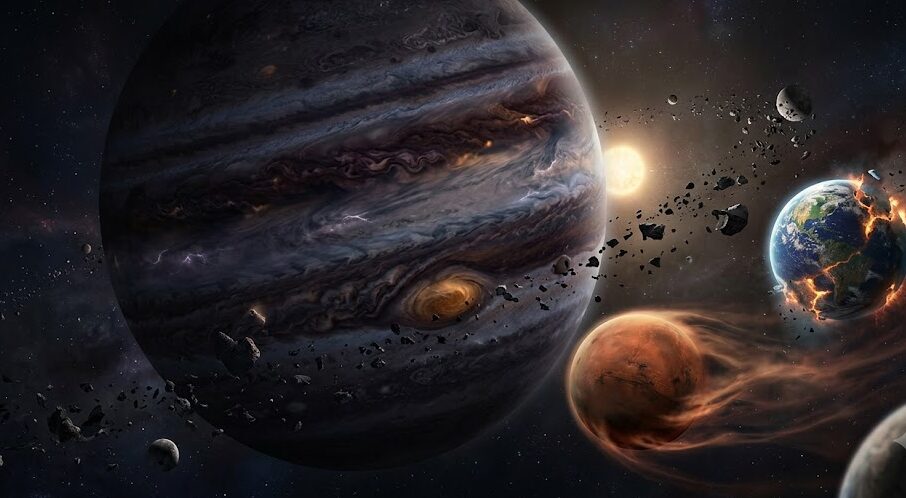
What if a rogue Jupiter-sized gas giant, cruising through the interstellar medium at 40 kilometers per second, had an orbital vector that brought it directly through the inner Solar System — passing between the orbits of Earth and Mars?
Here is the terrifying astrophysical simulation of what happens when a dark nomad enters our home.
1. Detection and the Approaching Menace
Because a rogue planet possesses no internal nuclear fusion, it emits virtually no visible light. In the cold of deep space, its gaseous envelope hovers at just 30 to 50 Kelvin.
The Infrared Warning
-
Infrared Discovery: The intruder would first be detected by space-based infrared observatories (such as the James Webb Space Telescope or the Vera C. Rubin Observatory) as a faint thermal anomaly warming slightly as it absorbs the distant Sun’s light.
-
Trajectory Calculation: Ground stations would watch in horror as supercomputers calculated its hyperbolic inbound trajectory: an unalterable flight path slicing directly through the ecliptic plane at an inclination of 12 degrees.
-
The Countdown: At 40 km/s, traveling from the Kuiper Belt (40 AU) to the inner system takes approximately 15 years — giving human civilization a agonizingly clear countdown to planetary judgment day.
2. The Inner System Entry: Shattered Resonance
As the rogue giant crosses the orbit of Mars (roughly 1.5 AU), its gargantuan gravitational field begins dominating the local gravitational potential of the inner Solar System.
The Chaotic Three-Body Problem
In gravitational physics, the Three-Body Problem (Sun, Earth, Rogue Giant) is inherently chaotic:
-
The Mars Ejection: Mars, having only 10% of Earth’s mass, is exquisitely vulnerable. A close flyby could kick Mars onto a collision course with Earth or fling it out of the Solar System entirely into the dark void.
-
The Asteroid Swarm: As the giant traverses the main asteroid belt, it scatters millions of rocky bodies. Thousands of metallic asteroids are flung inward toward Earth, generating an intense barrage of apocalyptic impacts.
3. The Close Approach: The Sky That Ate the World
In the most dramatic scenario modeled by planetary dynamicists, the rogue planet passes within 2,000,000 kilometers of Earth (roughly five times the distance to the Moon).
Tidal Rips and Continental Fractures
For several terrifying weeks:
-
The gas giant swells in our sky, transforming from a bright star into a terrifying, striped planetary colossus filling 15 to 30 degrees of the night sky.
-
Its massive gravitational tidal gradient exerts colossal strain on Earth’s crust:
-
Ocean tides do not merely rise meters — they surge hundreds of meters high, washing over entire coastal mountain ranges and drowning continents in global mega-tsunamis.
-
Earth’s solid crust flexes violently, triggering simultaneous volcanic eruptions along the entire Pacific Ring of Fire and unleashing magnitude 9.5+ earthquakes globally.
-
The Moon’s delicate orbit is violently disrupted: Luna is either ripped away to become a moon of the rogue giant, flung into the Sun, or pulled onto an unstable Earth-crossing collision orbit.
4. The Aftermath: The Interstellar Orphan
Once the rogue giant speeds past and leaves the Solar System on its hyperbolic journey, Earth is left forever transformed. In over 60% of computational simulations, Earth does not remain in its habitable orbit.
The Ice-Bound Cosmic Wanderer
-
Ejected Into the Void: Earth achieves hyperbolic excess velocity relative to the Sun, permanently breaking solar orbit. Earth itself becomes a rogue planet.
-
The Long Freeze: Within months, surface temperatures plunge past -50°C, then -100°C. Within a year, atmospheric carbon dioxide freezes into dry ice, followed eventually by liquid oxygen and nitrogen pooling on the ground.
-
Sub-Glacial Survival: Under miles of frozen ocean surface, geothermal vents continue to heat the abyssal depths. Life and surviving technological human colonies in nuclear-powered deep-sea habitats persist for millions of years, drifting silently through the galaxy.
5. Comparative Matrix: Rogue Gas Giant Flyby Outcomes
| Distance of Closest Approach | Orbital Consequence for Earth | Biospheric Outcome |
|---|---|---|
| Far (> 5.0 AU) | Minor orbital eccentricity perturbation | Mild global climate shifts; survival guaranteed. |
| Intermediate (1.0 to 3.0 AU) | Earth shifted into highly eccentric orbit | Extreme boiling summers and freezing winters. |
| Close (0.05 to 0.2 AU) | Earth ejected from the Solar System | Oceans freeze; Earth becomes an interstellar rogue world. |
| Ultra-Close (< 0.01 AU) | Gravitational tidal shredding / Capture | Complete planetary fragmentation into a debris ring. |
Frequently Asked Questions
Could humanity use nuclear weapons to deflect a rogue planet?
No. A gas giant possesses hundreds of trillions of times the mass of all human nuclear arsenals combined. Humanity could no more deflect a Jupiter-mass planet than a mosquito could deflect a speeding freight locomotive.
Could Earth be captured as a moon of the rogue gas giant?
Yes, in a rare orbital capture scenario. If the velocities align precisely, Earth could become a moon orbiting the gas giant, heated by tidal friction and lingering core thermal radiation as both bodies drift into deep space together.
WhatIfLab Speculative Science Monograph #16. N-body symplectic integrator algorithms, Roche limit tidal disruption mechanics, and rogue planetary ejection kinetics.