🚀 Key Scientific Takeaways
- Orbital Stability Threshold: To maintain long-term orbital stability without colliding or ejecting one another, the two moons must either orbit in a stable mean-motion resonance (such as 2:1) or occupy mutually exclusive orbital zones separated by several Hill radii.
- Hyper-Tidal Regimes: When both moons align (syzygy), tidal forces would combine constructively, producing monster tides up to 10 to 15 meters high, submerging low-lying coastal plains twice every month.
- Extreme Lithospheric Heating: Competing gravitational vectors would create internal tidal flexure within Earth’s mantle, increasing geothermal flux, magma displacement, and global volcanic activity.
- Evolutionary Adaptations: A dual lunar cycle would eliminate true darkness for most of the month, radically reshaping nocturnal predator-prey dynamics, navigation, and human calendar systems.
For billions of years, Earth’s solitary moon has stood as an anomalous giant among the terrestrial worlds of the inner Solar System. Mercury and Venus possess no satellites whatsoever; Mars captures only two potato-shaped captured asteroids, Phobos and Deimos, whose gravitational influence on the Martian surface is practically negligible. Earth’s Moon, by contrast, possesses roughly 1.2% of our planet’s mass — making the Earth-Moon system behave in many orbital respects like a binary planetary pair.
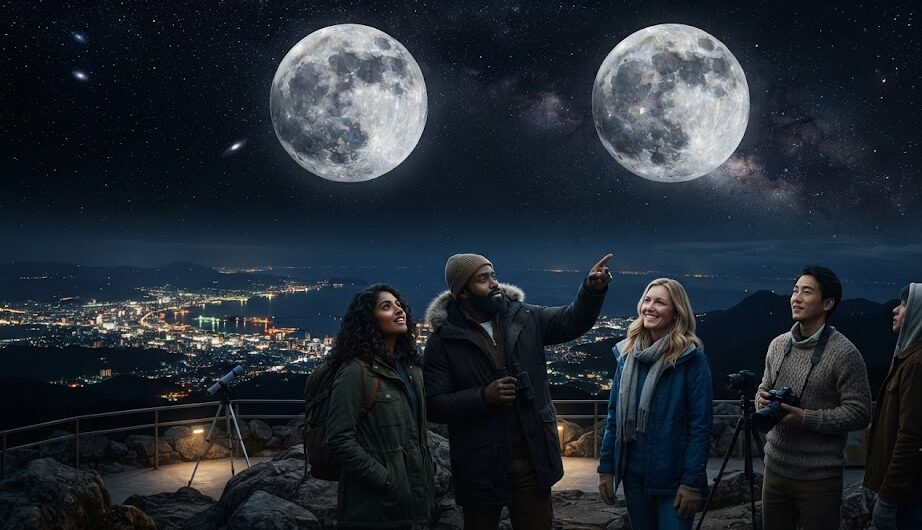
Now, imagine looking into our evening sky and beholding two colossal celestial spheres orbiting side by side: our familiar Luna, joined by a second twin satellite — let us call her Selene — possessing identical mass, density, and albedo.
While such a vision is a staple of science fiction and fantasy landscape art, the cold equations of orbital mechanics, gravitational field tensors, and tidal dissipation reveal a turbulent reality. Could two massive moons coexist stably around a terrestrial planet? How would their competing gravitational pull rewrite the contours of Earth’s coastlines, accelerate the fracturing of continental plates, and alter the path of biological evolution?
1. The Orbital Mechanics of Dual Moons: Chaos vs. Resonance
To place a second moon of equal mass (~7.35 × 10²² kg) into orbit around Earth, celestial dynamicists must solve a precarious three-body gravitational problem. If two large moons are placed arbitrarily, their mutual gravitational attraction will inevitably distort their orbital paths into chaotic eccentricities, leading to one of three catastrophic outcomes: an orbital ejection into the Sun, a collision with each other, or a direct impact with Earth.
The Stable Resonant Architecture
For two equal-mass moons to persist for millions of years, they must occupy distinct, non-overlapping orbital shells governed by orbital resonance:
-
Moon 1 (Inner Moon): Positioned closer to Earth, say at approximately 240,000 kilometers (orbital period: ~14.5 days).
-
Moon 2 (Outer Moon): Positioned at approximately 384,000 kilometers (our current Moon’s distance, with an orbital period of ~29.5 days).
In this 2:1 mean-motion resonance — reminiscent of Jupiter’s Galilean moons Io, Europa, and Ganymede — the inner moon completes exactly two full revolutions for every single orbit of the outer moon. Whenever the two bodies make their closest approach, they do so at consistent orbital milestones, preventing runaway eccentricities from destabilizing the system.
The Horseshoe Orbit Alternative
Alternatively, the two moons could theoretically share the same orbital distance if they were locked in a “horseshoe co-orbital resonance,” similar to Saturn’s moons Janus and Epimetheus. In this scenario, the two moons would drift toward one another every few years, exchange orbital momentum without ever touching, and smoothly reverse their relative motion. However, for objects as massive as our Moon, gravitational shears during the exchange phase would unleash titanic tidal surges on Earth during every close encounter.
2. Tidal Warfare: Monster Surges and Coastal Inundation
Tidal forces scale inversely with the cube of distance ($F_t \propto 1/r^3$). An inner moon positioned at 240,000 kilometers would exert roughly four times the tidal force of our current Moon. When combined with the outer moon, Earth’s oceanic dynamics would transform into an unpredictable, turbulent battleground of constructive and destructive wave interference.
Syzygy Super-Tides
Every 29.5 days, a celestial alignment occurs where both moons, Earth, and the Sun line up in a straight line (syzygy). During these alignments:
-
The gravitational tidal bulges of both moons and the Sun stack on top of each other in maximum constructive interference.
-
Ocean tides would surge to staggering heights of 10 to 18 meters (30 to 60 feet) along continental shelves.
-
Coastal regions across the planet — including cities like New York, London, Tokyo, and Mumbai — would be permanently underwater or subject to catastrophic bi-monthly inundation. Coastal civilization as we know it could not exist at sea level; cities would be built high on rocky cliffs or miles inland.
Complex Tidal Harmonics and Chaotic Currents
When the two moons are in quadrature (positioned at 90 degrees relative to each other), their tidal forces would pull at right angles. The resulting ocean currents would form gargantuan mid-ocean whirlpools, chaotic rip currents, and violent maritime bottlenecks, making traditional naval navigation without modern satellite positioning virtually suicidal.
3. Geological Upheaval: Mantle Flexure and Super-Volcanism
The Moon’s gravitational pull does not stop at the water’s edge. It flexes the silicate rock of Earth’s lithosphere and upper mantle. With two moons exerting strong, desynchronized gravitational tugs:
The Io Effect on Earth
Jupiter’s volcanic moon, Io, is the most geologically active body in the Solar System because it is caught in a gravitational tug-of-war between Jupiter, Europa, and Ganymede. This constant gravitational stretching generates immense internal frictional heat, melting Io’s interior into liquid magma.
While Earth would not become as extreme as Io, the presence of two massive moons would significantly increase internal tidal dissipation:
-
Sub-Crustal Melting: The continual knead of the Earth’s mantle would increase sub-crustal temperatures, generating higher volumes of magma beneath tectonic boundaries.
-
Accelerated Plate Tectonics: Plate movement would accelerate, leading to more frequent mega-thrust earthquakes (magnitude 8.5+) and active volcanic arc eruptions.
-
Atmospheric Aerosol Loading: Increased continuous volcanism would pump massive quantities of sulfur dioxide and ash into the stratosphere, inducing cyclic volcanic winters and acid rain showers.
4. Comparative Matrix: Single Moon vs. Dual Moon System
Below is a detailed empirical breakdown comparing Earth’s current parameters with a twin-satellite reality:
| Parameter | Single Moon (Current Reality) | Dual Moon System (2:1 Resonance) | Physical & Ecological Result |
|---|---|---|---|
| Max Tidal Range | 1 to 4 meters (Open Coast) | 10 to 18 meters (Constructive Syzygy) | Widespread loss of habitable low-altitude coastlines worldwide. |
| Night Sky Darkness | Full darkness during New Moon | True darkness rare (< 2 nights/month) | Night illuminated by at least one lunar disc almost every evening. |
| Day Length Braking | +1.7 ms / century | +6.2 ms / century | Days slow down nearly 4x faster due to combined tidal drag. |
| Seismic & Volcanic Activity | Moderate, plate-driven | High, plate + tidal-flexure driven | Increased magma generation and continuous volcanic emissions. |
| Solar Eclipse Frequency | Rare (Roughly twice a year) | Highly Frequent (Multiple per month) | Near-weekly partial or total solar eclipses somewhere on Earth. |
| Human Calendar Complexity | Simple 12-month solar/lunar calendar | Complex dual-cycle poly-harmonic calendar | Calendars would track both inner and outer lunar cycles simultaneously. |
5. Biological Evolution and Nocturnal Life Under Two Moons
How would terrestrial and marine life evolve under the perpetual glow of two shifting celestial spotlights?
The Elimination of Pitch-Black Nights
Because the inner moon orbits every 14.5 days and the outer moon orbits every 29.5 days, their orbital phases are constantly shifting relative to one another. One moon might be in its full phase while the other is at first quarter:
-
Pitch-black nights would become an exceedingly rare planetary phenomenon, occurring only on the rare occasions when both moons enter their “New Moon” phase simultaneously.
-
Nocturnal organisms that rely on absolute darkness to avoid apex predators — such as small rodents, nocturnal lemurs, and amphibians — would face extreme evolutionary pressure to evolve superior camouflage, subterranean burrowing habits, or reflective counter-shading.
-
Predators would develop hyper-acute optical vision optimized for dynamic dual-shadow illumination.
The Spectacular “Double Eclipse” Phenomenon
With two moons traversing different planes and speeds, solar and lunar eclipses would become frequent spectacles:
-
The Double Solar Eclipse: The inner moon would frequently transit across the Sun, only to be followed hours later by the outer moon.
-
Mutual Lunar Occultations: On regular occasions, the inner moon would pass directly between Earth and the outer moon, creating a surreal spectacle where one glowing moon eclipses another in the night sky.
Frequently Asked Questions
Could two moons collide with each other?
Yes, if their orbital orbits are not locked in stable resonances. If one moon’s orbit becomes eccentric due to gravitational perturbations, their paths could intersect. A collision between two lunar-sized bodies would pulverize both satellites into an apocalyptic debris ring, sending trillions of tons of meteoric shrapnel raining down onto Earth.
How would two moons affect human sleep and circadian rhythms?
Human sleep architecture is sensitive to ambient nocturnal light. With bright moonlight persisting almost every night of the month, human melatonin synthesis would be chronically suppressed without modern blackout window technology, potentially driving evolutionary adaptations in neurochemistry and sleep cycles.
WhatIfLab Speculative Science Monograph #02. Three-body gravitational resonance simulations, tidal vector summation, and lithospheric stress dissipation models.