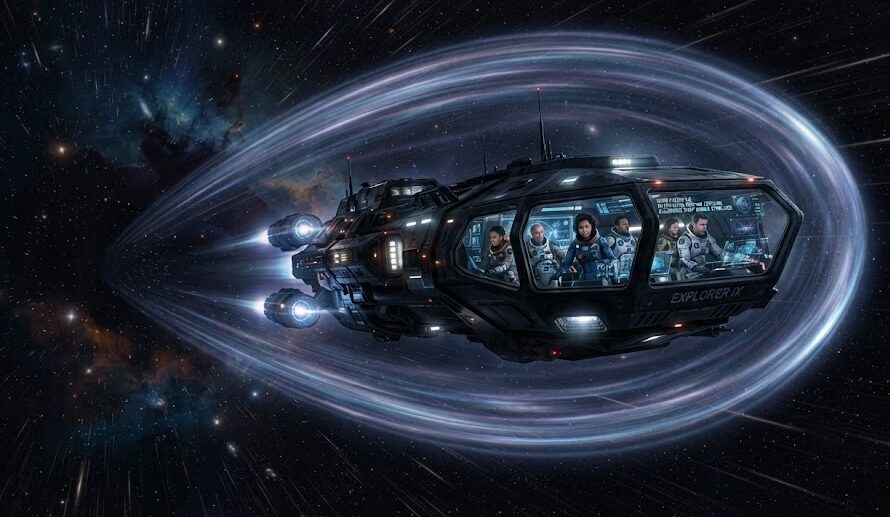
🚀 Key Scientific Takeaways
- The Loophole in Einstein’s Law: Special Relativity forbids any physical object from accelerating through local space faster than $c$. However, General Relativity permits spacetime itself to expand and contract at arbitrary speeds without violating physical causality.
- The Alcubierre Metric (1994): Mexican theoretical physicist Miguel Alcubierre proved that a warp bubble — contracting space ahead of a vessel and expanding space behind it — enables effective superluminal transit while the ship remains stationary in free-fall inside.
- Zero Time Dilation: Because the ship inside the warp bubble does not experience local relativistic acceleration, astronauts experience no Lorentz time dilation; clocks aboard the vessel tick at the exact same rate as clocks on Earth.
- The Deceleration Death Wave: During superluminal transit, the leading edge of the warp bubble sweeps up high-energy cosmic dust and photons. Upon dropping out of warp, this accumulated energy is released forward in an apocalyptic beam capable of vaporizing entire destination planetary systems.
For over a century, the speed of light ($c = 299,792,458\text{ m/s}$) has stood as the supreme cosmic speed limit. According to Einstein’s Special Theory of Relativity, as a physical object with mass accelerates toward light speed, its relativistic mass increases toward infinity, requiring an infinite amount of kinetic energy to accelerate that final fractions of a percent.
Interstellar space is terrifyingly vast. At conventional chemical rocket speeds, a voyage to our closest neighboring star system, Alpha Centauri (4.24 light-years away), takes over 70,000 years. Even using advanced nuclear fusion propulsion, travel times span centuries.
Then, in 1994, Mexican theoretical physicist Miguel Alcubierre discovered a brilliant mathematical loophole hidden within Einstein’s own General Theory of Relativity.
Alcubierre asked a radical question: What if the starship does not move through space at all? What if space moves around the starship?
His resulting paper, “The Warp Drive: Hyper-Fast Travel Within General Relativity,” demonstrated that an engineered bubble of curved spacetime could propel a vessel across the galaxy at ten, fifty, or a hundred times the speed of light — without violating local relativity.
What if humanity cracked the physics of the Alcubierre Warp Drive? Here is the rigorous science, engineering barriers, and cosmological paradoxes of true faster-than-light travel.
1. How the Warp Bubble Works: Surfing Spacetime
The fundamental insight of General Relativity is that spacetime is not an empty, passive void; it is a dynamic, physical fabric that can bend, warp, stretch, and compress under energy and mass.
The Contracting and Expanding Envelope
The Alcubierre metric constructs a unique gravitational tensor field:
-
Ahead of the Starship: Spacetime is violently compressed and shrunk. A light-year of distance is flattened into a few meters.
-
Behind the Starship: Spacetime is rapidly expanded and stretched, pushing the vessel forward like a surfer riding an ocean wave.
-
Inside the Warp Bubble: The starship sits inside a flat, uncurved region of spacetime (the “passenger cabin”).
Because the ship is at rest relative to the local space inside the bubble:
-
The astronauts feel zero g-forces and zero acceleration inertia. You could sip hot coffee without spilling a single drop while the bubble accelerates to ten times the speed of light in less than a microsecond.
-
No Relativistic Time Dilation: Unlike near-light-speed travel — where centuries pass on Earth while crew members age only days — clocks inside an Alcubierre bubble tick in perfect synchrony with terrestrial time. A 4-light-year trip at $4c$ takes exactly one Earth year, and the crew ages exactly one year.
2. The Engineering Bottleneck: The Quest for Exotic Matter
Why do we not have warp drives today? In Alcubierre’s original 1994 equations, generating the necessary warp bubble required a catastrophic catch: negative energy density.
From the Mass of the Universe to a Few Kilograms
-
The Original Calculation: Alcubierre’s initial mathematical formulation required an amount of negative energy equivalent to the total mass of the observable universe ($-10^{53}\text{ kg}$) to power a 100-meter vessel.
-
The White-Van Den Broeck Optimization: In 1999 and subsequent NASA Eagleworks research led by Dr. Harold “Sonny” White, physicists optimized the geometry:
-
By oscillating the thickness of the warp bubble wall and shifting the ring geometry from a flat band to a toroidal donut shape, the energy requirement was drastically slashed from an entire universe down to roughly the mass of an asteroid (or a few hundred kilograms of exotic matter converted via $E = mc^2$).
-
Positive-Energy Solitons: In recent groundbreaking papers published in 2021 by astrophysicists Erik Lentz and Alexey Bobrick, new mathematical configurations of warp metrics have been discovered that may operate using purely positive classical energy, bringing the theory a major step closer to physical reality.
3. The Lethal Trap: The Deceleration Forward-Blast
The most terrifying hazard of superluminal warp flight is not engine failure; it is what happens when you arrive at your destination.
The Cosmic Snowplow Effect
As a warp bubble travels through interstellar space at superluminal speeds:
-
The leading shockwave of the bubble acts like a gravitational snowplow, sweeping up interstellar hydrogen atoms, cosmic rays, micro-meteoroids, and stray photons.
-
These trapped particles are continuously blueshifted and accelerated along the leading edge of the bubble, accumulating immense kinetic and radiative energy over light-years of travel.
-
The Annihilation Pulse: The instant the starship turns off its warp drive and drops back into normal space at its destination, all accumulated particles are violently discharged forward in a hyper-collimated death-beam of gamma rays and relativistic shrapnel.
-
If a starship drops out of warp pointing directly at an orbital space station or an inhabited colony planet, this forward-blast would incinerate the atmosphere and sterilize the surface in milliseconds. Warp navigators would be legally mandated to decelerate millions of kilometers away in empty interplanetary space.
4. Comparative Matrix: Relativistic Sub-Light vs. Alcubierre Warp Travel
| Flight Parameter | Sub-Light Relativistic Flight ($0.99c$) | Alcubierre Superluminal Warp ($10c$) | Practical Mission Reality |
|---|---|---|---|
| Alpha Centauri Travel Time | 4.28 Earth Years (Crew: ~7 months) | 5.1 Months (Both Earth and Crew) | No temporal divergence between home and explorers. |
| G-Force Acceleration | Brutal; requires slow multi-year boost | Zero G-forces; instant velocity | Crew floats in comfortable free-fall at all times. |
| Time Dilation Paradox | Severe (Decades pass on Earth) | Zero (Synchronized with Earth clocks) | Astronauts return home to friends of the same age. |
| Propulsion Physics | Momentum ejection (Rockets / Sails) | Metric spacetime curvature tensors | Ships possess no massive propellant fuel tanks. |
| Causality Paradox Risk | Zero (Complies with light cone) | High (Can construct closed timelike loops) | Potential violation of universal causality / time loops. |
Frequently Asked Questions
Could an Alcubierre warp drive be used to travel back in time?
Under strict Special Relativity, any superluminal transit can be mapped onto a reference frame where an observer sees the ship arrive before it departed. If combined with two relativistic reference frames, an Alcubierre ship could theoretically create a Closed Timelike Curve (CTC), enabling time travel to the past — prompting physicists like Stephen Hawking to argue that quantum gravity must naturally suppress warp metrics.
Can a crew steer a warp bubble from the inside?
This is the “horizon problem” of warp physics. Because the outer wall of the bubble moves faster than light relative to the interior, signals sent from the bridge cannot reach the front of the bubble to turn it off. Future engineering designs propose pre-programmed autonomous quantum timers or exterior guidance laser networks laid out along interstellar travel corridors.
WhatIfLab Speculative Science Monograph #23. Alcubierre metric stress-energy tensors, Lentz positive-energy soliton geometries, and superluminal particle accumulation dynamics.