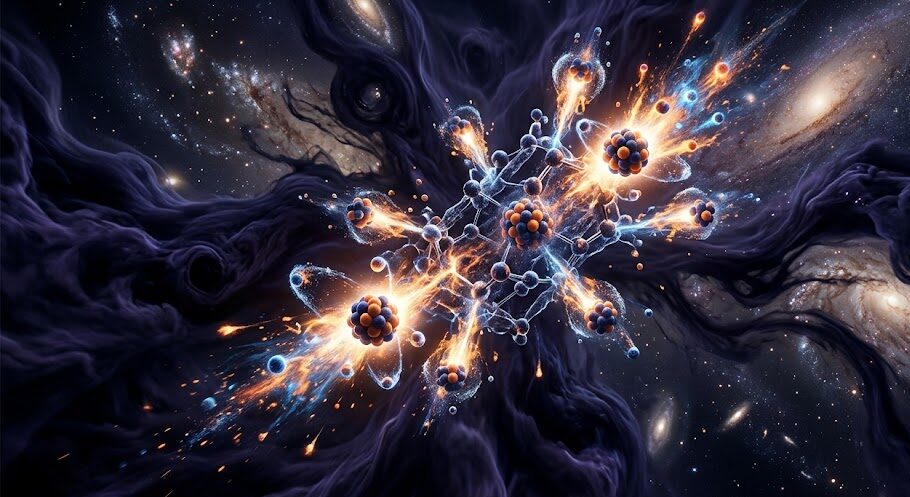
🚀 Key Scientific Takeaways
- Phantom Dark Energy: In cosmological models where the dark energy equation-of-state parameter $w < -1$, dark energy density increases over time rather than remaining constant, accelerating cosmic expansion to infinite velocity.
- The Inverted Collapse: Unlike the gentle, slow heat death of the Big Freeze, the Big Rip ends in a finite time singularity where every bound gravitational, electromagnetic, and nuclear structure is violently ripped apart.
- The Chronological Cascade: The destruction cascades down through scales of physical size: first galactic superclusters dissolve, then individual galaxies, then planetary orbits, then planets, and finally molecular bonds and subatomic quarks.
- The Final Singularity: At the moment of the Rip (time $t_{\text{rip}}$), the scale factor of the universe reaches infinity, terminating time, space, and physical causality in an infinite quantum tear.
How will our universe end?
For decades, cosmologists debated three classic scenarios governed by Einstein’s Friedmann equations:
-
The Big Crunch: Gravity halts cosmic expansion and pulls all matter back into a scorching universal singularity.
-
The Big Freeze (Heat Death): The universe expands forever, cooling down over trillions of years until all stars burn out and black holes slowly evaporate.
-
The Big Bounce: Cyclic expansions and contractions oscillating for eternity.
Then, in 1998, observations of distant Type Ia supernovae by Saul Perlmutter, Brian Schmidt, and Adam Riess revealed an astonishing shock: the expansion of the universe is not slowing down — it is accelerating.
The culprit was dubbed Dark Energy: a mysterious repulsive energy comprising approximately 68% of the total mass-energy budget of the cosmos.
In 2003, theoretical physicist Robert Caldwell of Dartmouth College proposed a terrifying fourth possibility: The Big Rip.
What if dark energy is not a quiet cosmological constant, but a runaway, accelerating form of phantom energy whose density grows exponentially with time?
Here is the chronological countdown to the ultimate death of spacetime.
1. The Physics of Phantom Dark Energy
In standard cosmology, dark energy is modeled by the equation-of-state parameter:
$$w = \frac{P}{\rho c^2}$$
Where $P$ is pressure and $\rho$ is energy density.
The Phantom Condition ($w < -1$)
-
If $w = -1$, dark energy behaves as Einstein’s Cosmological Constant (constant energy density per volume).
-
If $w < -1$, dark energy is dubbed Phantom Energy:
-
As the universe expands, phantom energy density does not dilute; it actually increases.
-
The repulsive gravitational force accelerates without limit, eventually becoming strong enough to overwhelm every other fundamental force of nature (gravity, electromagnetism, and the strong and weak nuclear forces).
The time remaining until the Big Rip singularity ($t_{\text{rip}}$) is calculated as:
$$t_{\text{rip}} – t_0 \approx \frac{2}{3 |1 + w|} \frac{1}{H_0 \sqrt{1 – \Omega_m}}$$
For $w = -1.5$, the Big Rip would occur roughly 22 billion years from the Big Bang (about 8 billion years from today).
2. The Countdown: From Galactic Clusters to Planetary Shredding
As the Big Rip approaches, the expanding fabric of space begins tearing apart structures from largest to smallest in an orderly, terrifying hierarchy:
T-Minus 1 Billion Years: Dissolution of Superclusters
-
Space expansion overpowers the gravitational bonds holding the Virgo Supercluster together.
-
Distant galaxies race away from our Local Group faster than the speed of light, vanishing past the cosmic cosmological horizon. The night sky outside our galaxy goes completely black.
T-Minus 60 Million Years: The Unraveling of the Milky Way
-
The repulsive force of phantom energy equals the gravitational pull of the galactic center.
-
The spiral arms of the Milky Way begin unwinding into space. Stars are stripped from their galactic orbits like leaves blown off an autumn tree, becoming isolated stellar wanderers in a boundless, black void.
T-Minus 3 Months: Planetary Orbits Severed
-
The repulsive acceleration penetrates the Solar System.
-
Neptune, Saturn, and Jupiter drift away from the Sun.
-
Exactly three months before the end, Earth breaks free from solar gravity, spiraling away into empty space.
3. The Final Hour: The Destruction of Solid Matter
In the final 60 minutes before $t_{\text{rip}}$, the acceleration of space reaches the scale of human everyday objects.
The Shattering of Worlds
-
T-Minus 30 Minutes: Earth’s internal gravitational cohesion is overwhelmed. The core, mantle, and crust crack apart in a colossal planetary explosion, vaporizing the solid planet into an expanding cloud of rocky shards.
-
T-Minus 10 Minutes: The Sun and all surviving stars in the universe can no longer contain their internal gas pressure; they detonate from the inside out in catastrophic stellar explosions.
-
T-Minus 1 Nanosecond ($10^{-9}\text{ seconds}$): The repulsive expansion overcomes electromagnetic bonding forces. Molecules, proteins, and chemical bonds are ripped apart. Living organisms, water, and solid materials dissolve into free atoms.
-
T-Minus 1 Attosecond ($10^{-18}\text{ seconds}$): The Strong Nuclear Force fails. Protons and neutrons are ripped apart into their constituent up and down quarks.
-
T = 0 (The Big Rip): Spacetime curvature reaches infinity. Spacetime itself ceases to exist. The universe ends in a timeless, spaceless singularity of infinite tear.
4. Comparative Matrix: The Four Fates of the Universe
| Cosmic Fate | Governing Physics | Final Timeline | Ultimate Physical State |
|---|---|---|---|
| The Big Freeze (Heat Death) | $w = -1$ (Cosmological Constant) | $10^{100}\text{ Years}$ | Cold, dark, expanding void; Hawking radiation evaporates black holes. |
| The Big Crunch | High matter density ($\Omega > 1$) | Decades of billions | Reverse expansion; cosmos collapses into universal firestorm. |
| The Big Rip | Phantom Energy ($w < -1$) | $\sim 22\text{ Billion Years}$ | Spacetime fabric tears apart; atoms, space, and time destroyed. |
| Vacuum Decay | Higgs vacuum metastability | Instantaneous (Random) | True vacuum bubble expands at light speed, rewriting physical laws. |
Frequently Asked Questions
Do current cosmological measurements favor the Big Rip?
Recent measurements from the Planck satellite and the Dark Energy Survey measure the dark energy parameter at $w = -1.03 \pm 0.03$. While this is consistent with a cosmological constant ($w = -1$, leading to the Big Freeze), the error bars still encompass the phantom energy regime ($w < -1$), leaving the Big Rip as an active theoretical possibility.
Could an advanced civilization escape the Big Rip?
Only by escaping our universe entirely. An advanced Type-III or Type-IV Kardashev civilization would need to engineer artificial wormholes into newborn baby universes or higher dimensional branes to survive the terminal shredding of our spacetime fabric.
WhatIfLab Speculative Science Monograph #25. Caldwell phantom energy metrics, scale-factor singularity equations, and cosmological boundary dissolution dynamics.