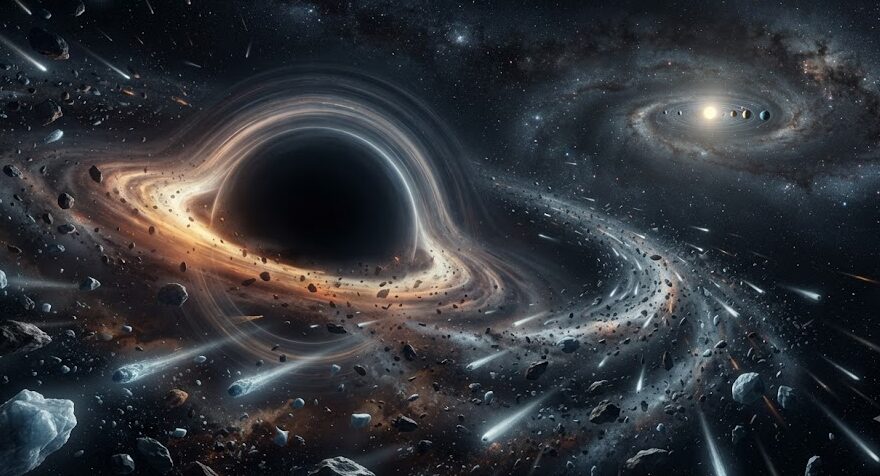
🚀 Key Scientific Takeaways
- The Missing Link: Intermediate-Mass Black Holes (IMBHs) — ranging between 100 and 100,000 solar masses — roam invisibly through the galactic halo, ejected from ancient globular clusters by gravitational recoil.
- Gravitational Shell Disruption: As an IMBH enters the Oort Cloud (10,000 to 50,000 AU from the Sun), its titanic gravitational field scatters billions of dormant icy comets like bowling pins.
- The Great Cometary Deluge: Millions of kilometer-sized comets are kicked onto radical inward trajectories, unleashing an unprecedented multi-millennium bombardment on Earth, Mars, and Jupiter.
- Inner Solar System Resonances: Even if the black hole passes tens of thousands of AU away, its secular gravitational torque can slowly tilt the planetary orbital plane and pump eccentricity into Earth’s orbit, altering global climates forever.
Astronomers estimate that between 10 million and 100 million isolated black holes wander silently through the interstellar expanse of our Milky Way galaxy. Born from the death of ancient hypermassive Population III stars or expelled from dense star clusters by violent gravitational kicks, these celestial phantoms emit no light, cast no direct shadows, and glide through the vacuum at hundreds of kilometers per second.
Among the most enigmatic of these wanderers are Intermediate-Mass Black Holes (IMBHs). Weighing between 500 and 10,000 solar masses, they are the “missing links” between modest stellar-mass black holes and the gargantuan supermassive giants lurking in galactic cores.
Surrounding our Solar System at a distance of 5,000 to 50,000 Astronomical Units lies the Oort Cloud: a spherical cosmic nursery containing trillions of frozen, primordial icy bodies — the cometary reservoir of our solar realm.
What would happen if an invisible, 1,000-solar-mass Intermediate Black Hole drifted through the outer perimeter of the Oort Cloud?
1. The Silent Approach: Detecting an Invisible Behemoth
Because an isolated black hole in deep space lacks a stellar companion from which to siphon gas, it possesses no brilliant, glowing accretion disc. It is essentially 100% invisible to conventional optical telescopes.
Gravitational Astrometric Lensing
Humanity’s first indication of the intruder would come from automated space astrometry surveys (such as ESA’s Gaia observatory):
-
As the black hole moves across the celestial sphere, its gravitational field bends the light of background stars into temporary Einstein rings and micro-lensing arcs.
-
Precision radio tracking of the Voyager 1 and Voyager 2 space probes, as well as anomalies in the telemetry of outer-system probes like New Horizons, would register subtle, anomalous acceleration vectors toward an empty patch of space in the constellation Cygnus.
-
Orbital computers would calculate a horrifying reality: an object weighing 1,000 times more than our Sun is cruising through the Oort Cloud at 45 kilometers per second.
2. The Shattered Cloud: The Great Cometary Bombardment
The Oort Cloud is barely tethered to the Sun. At 20,000 AU, the Sun’s gravitational pull is a whisper, balanced delicately against the galactic tide.
Scattering Trillions of Icy Missiles
When a 1,000-solar-mass black hole passes through:
-
Its gravitational sphere of influence completely dominates the local Oort Cloud.
-
Trillions of comets have their delicate circular orbits violently sheared. Roughly half are ejected into the interstellar void as rogue cometary orphans.
-
The remaining half are perturbed into extreme, highly eccentric orbits plunging straight into the inner Solar System.
-
Within several thousand years (a blink in astronomical time), Earth would face an era of hyper-impact bombardment rivaling the Late Heavy Bombardment of 4 billion years ago. Thousands of massive comets, each measuring 5 to 50 kilometers in diameter, would streak through the inner system annually.
3. Secular Gravitational Torques on Planetary Orbits
Even if the black hole never penetrates deeper than 10,000 AU, its massive gravitational mass creates long-term secular orbital resonances across the entire Solar System.
Kozai-Lidov Perturbations
Through the Kozai-Lidov mechanism:
-
The gravitational torque from the distant black hole tilts the invariable plane of the Solar System.
-
Neptune and Uranus, being closest to the disturbance, experience severe orbital eccentricities, potentially swapping orbits or colliding with the gas giants.
-
Earth’s orbital eccentricity would be pumped to extreme values ($e > 0.2$). Instead of our current nearly circular orbit, Earth would swing close to the Sun at perihelion (boiling summers) and drift far outward at aphelion (freezing winters), completely destabilizing the Holocene climatic equilibrium.
4. Comparative Matrix: Standard Oort Cloud vs. Disrupted Oort Cloud
| Dynamic Parameter | Undisturbed Solar System | IMBH Disruption (10,000 AU Flyby) | Civilizational Threat |
|---|---|---|---|
| Inward Comet Rate | ~1 to 5 observable comets/year | Hundreds of thousands per century | Continuous existential impact extinction risks. |
| Planetary Orbital Plane | Flat (Aligned to ecliptic $\pm 7°$) | Warped, tilted by several degrees | Disruption of long-term Milankovitch cycles. |
| Kuiper Belt Stability | Stable resonances with Neptune | Chaotic scattering of dwarf planets | Sedna and Pluto perturbed into crossing orbits. |
| Solar Velocity relative to Galaxy | ~230 km/s (Galactic Orbit) | Altered by several km/s | Solar System deflected onto a new galactic path. |
| Space Warning Time | Decades to centuries | Years (due to lack of electromagnetic emission) | Extremely compressed window for planetary defense. |
Frequently Asked Questions
Could Jupiter protect Earth from the cometary deluge?
Jupiter is our “cosmic vacuum cleaner,” whose massive gravitational field deflects or absorbs many incoming comets. However, during an Oort Cloud disruption involving millions of comets, Jupiter’s gravitational cross-section is simply too small to intercept more than a tiny fraction, leaving terrestrial planets exposed.
Could the black hole swallow the Sun?
Only if it achieved a direct collision vector within a few AU. At Oort Cloud distances (10,000+ AU), the black hole would simply pass through on a hyperbolic trajectory, perturbing the system before continuing its lonely voyage into the interstellar dark.
6. Planetary Defense: Could Technological Civilization Survive?
Faced with a thousand-year cometary bombardment triggered by an Oort Cloud intruder, human survival would require transitioning from terrestrial civilization to an interplanetary defensive species.
Deep-Space Kinetic Interceptors and Laser Deflection
Traditional planetary defense strategies like nuclear impactors would be hopelessly inadequate against thousands of comets arriving simultaneously from every inclination:
-
The Strategic Asteroid Network: Humanity would need to establish automated laser ablation arrays across the asteroid belt. High-energy gigawatt lasers firing continuously at incoming comets would vaporize surface ices, creating natural rocket plumes that gently deflect the comets away from Earth-crossing orbits.
-
Subterranean Biospheres: On Earth, civilizational redundancy would mandate the construction of self-contained subterranean and deep-ocean biospheres capable of sustaining millions of inhabitants through centuries of impact-induced nuclear winters.
WhatIfLab Speculative Science Monograph #13. N-body gravitational scattering, Kozai-Lidov secular resonance equations, and Oort Cloud cometary perturbation dynamics.