🚀 Key Scientific Takeaways
- The Carrington Precedent: In 1859, the most powerful recorded geomagnetic storm struck Earth, setting telegraph wires on fire and causing auroras visible at the equator. A similar storm today would strike an infinitely more vulnerable electronic civilization.
- Geomagnetically Induced Currents (GICs): The sudden compression of Earth’s magnetic field drives hundreds of amperes of DC current into high-voltage electrical transmission lines, melting the copper windings of critical step-up transformers in minutes.
- Orbital Slaughter: Low Earth Orbit satellites face catastrophic atmospheric drag expansion and high-energy proton charging, crippling GPS, financial transaction timestamping, and telecommunications.
- Economic Devastation: Rebuilding destroyed high-voltage electrical transformers — which take 12 to 24 months to custom manufacture — could plunge advanced nations into a multi-year economic depression with damages exceeding $2 trillion.
In the late summer of 1859, British astronomer Richard Carrington pointed his brass telescope at a massive cluster of dark sunspots bubbling across the solar photosphere. At 11:18 AM, he witnessed an astonishing phenomenon: two blinding beams of white light erupted from the sunspot core, blazing intensely for five minutes before vanishing into the solar mantle.
Carrington had observed the first recorded solar superflare.
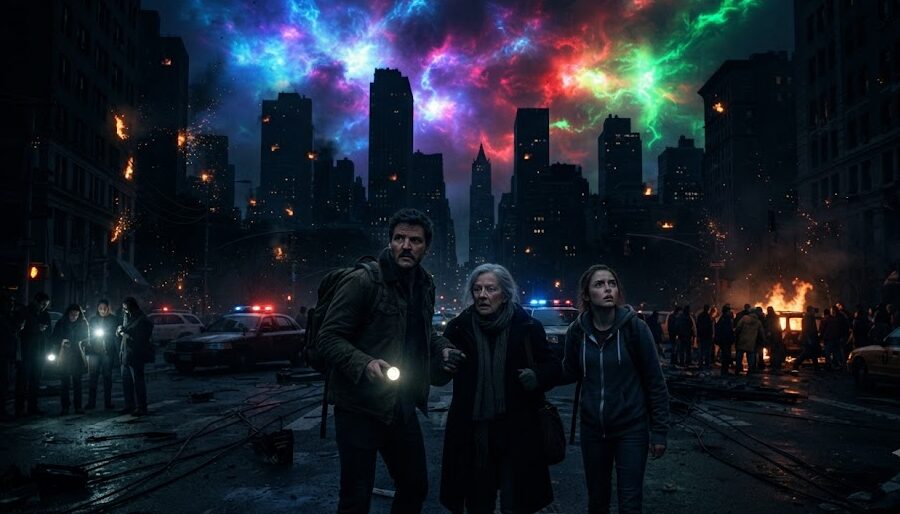
Seventeen hours later, a titanic cloud of magnetized plasma — a Coronal Mass Ejection (CME) hurtling through space at eight million kilometers per hour — slammed directly into Earth’s magnetosphere. The night sky erupted in incandescent crimson, violet, and green auroras so blindingly bright that birds in Boston began singing at 1:00 AM, thinking morning had arrived, and gold miners in the Rocky Mountains cooked breakfast by auroral light. Across Europe and North America, early telegraph networks sparked violently, shocking operators, setting paper reels on fire, and continuing to send phantom messages even after their chemical batteries were completely disconnected.
In 1859, humanity operated on steam, coal, and horses; the damage was a technological novelty.
Today, human civilization is completely encased in a gossamer web of microchips, fiber optics, high-voltage copper grids, GPS satellites, and synchronized digital finance. What would happen if an identical — or more powerful — X50-class Carrington-level superstorm struck Earth tomorrow?
1. Anatomy of the Strike: The Three Waves of Solar Fury
A solar superstorm is not a single blast. It attacks Earth in three distinct waves, each governed by different physics and traveling at different velocities across the 150-million-kilometer gulf.
Wave 1: The Electromagnetic Shock (Travel Time: 8.3 Minutes)
The initial solar flare releases a devastating flash of high-energy X-rays and extreme ultraviolet (EUV) radiation traveling at the speed of light:
-
It hits Earth’s sunlit upper atmosphere in just 500 seconds.
-
The radiation strips electrons from atmospheric atoms, super-ionizing the D-region of the ionosphere.
-
High-frequency (HF) radio communications — used by maritime shipping, international aviation, and emergency military protocols — instantly black out across the entire daylight hemisphere.
Wave 2: The Solar Particle Event (Travel Time: 30 to 60 Minutes)
Behind the photon flash comes a tsunami of relativistic protons and heavy ions accelerated to over 80% of light speed:
-
These subatomic bullets pierce through satellite shielding, flipping bits in computer memory (single-event upsets) and blinding star-tracker navigation cameras.
-
Commercial airline passengers and crews flying polar routes absorb dangerous radiation doses equivalent to dozens of chest X-rays within hours, forcing emergency flight diverts.
-
Astronauts aboard the International Space Station or Artemis lunar missions must immediately shelter in heavily reinforced water-shielded survival modules to avoid fatal radiation sickness.
Wave 3: The Coronal Mass Ejection (Travel Time: 15 to 24 Hours)
The true hammer: a multi-billion-ton cloud of magnetized solar plasma compressing Earth’s magnetosphere from its normal distance of 60,000 kilometers down to less than 20,000 kilometers — below the orbits of geostationary satellites.
2. The Transformer Meltdown: Why Power Grids Burn
The primary mechanism of modern civilizational destruction is Geomagnetically Induced Currents (GICs).
Faraday’s Law on a Continental Scale
As the massive magnetic field of the CME fluctuates violently against Earth’s magnetic shield, it induces electrical currents in the crust of our planet (Faraday’s Law of Induction: $\mathcal{E} = -d\Phi_B/dt$).
Electricity follows the path of least resistance. Instead of traveling through high-resistance igneous bedrock, these induced currents seek out the grounded neutral connections of national high-voltage electrical grids:
-
Massive Direct Current (DC) surges flood into Alternating Current (AC) transmission grids.
-
Extra-High-Voltage (EHV) step-up transformers are pushed deep into magnetic saturation.
-
The internal steel cores of these 300-ton transformers heat up to hundreds of degrees Celsius within minutes. Cooling oil boils, dielectric insulation catches fire, and the copper windings fuse into charred, molten slag.
Hundreds of critical transformers across North America, Europe, China, and India would simultaneously incinerate. These machines cannot be repaired on-site; they are custom-built giants with global manufacturing lead times of 12 to 24 months.
3. The Cascading Domino Effect: 48 Hours Without Power
Within hours of the transformer burn-out, the fragile, interdependent systems of modern society begin collapsing in a brutal, rapid cascade:
-
Water Supply Halts (Hour 6): Municipal water treatment plants and high-rise booster pumps require continuous electrical grid power. Tap water ceases flowing across metropolitan areas.
-
Fuel Distribution Paralyzed (Hour 12): Gas station pumps cannot function without electricity. Diesel backup generators for hospitals and data centers run dry within 48 to 72 hours, with no ability to pump new fuel from underground storage tanks.
-
The Financial Freeze (Hour 24): Without GPS satellite atomic clock synchronization (which timestamps every modern financial transaction) and with regional data centers dark, digital banking, ATMs, credit card processing, and international wire transfers halt instantly. Paper cash becomes the only viable currency, quickly followed by barter.
-
Food Supply Chain Failure (Hour 72): Modern cities maintain only a 3-day supply of food in grocery stores. Without refrigeration and with logistics trucking fleets unable to refuel, severe food shortages strike within one week.
4. Quantitative Matrix: 1859 Carrington Event vs. Modern Superstorm
| Parameter | 1859 Carrington Event | Modern Carrington-Level Strike | Societal / Technological Fallout |
|---|---|---|---|
| CME Velocity | ~2,200 km/s (Fast) | 2,500 to 3,000 km/s | Warning time compressed to under 16 hours. |
| Magnetometer Deflection | -850 to -1,600 nT | -1,200 to -2,000 nT | Titanic crustal GIC current generation. |
| Vulnerable Technology | Primitive telegraph wires | Microelectronics, satellites, power grids | Catastrophic multi-trillion-dollar infrastructure destruction. |
| Satellites in Orbit | 0 | Over 10,000 active satellites | Widespread satellite orbital decay and electronic burnout. |
| Estimated Economic Cost | < $10 Million (Adjusted) | $2.5 Trillion to $5 Trillion | Global multi-year supply chain depression. |
| Recovery Timeline | Days (Telegraph wires spliced) | 1 to 5 Years (Transformer replacement) | Prolonged energy rationing and national grid reconstruction. |
5. Planetary Defense: Can Humanity Protect Itself?
Unlike earthquakes or asteroid impacts, a solar superstorm gives a clear, unambiguous warning window: the 15 to 20 hours between the solar flare flash and the arrival of the CME.
If space weather agencies (such as NOAA’s Space Weather Prediction Center) detect a Carrington-class CME on a direct collision course:
-
The Controlled Controlled Shutdown: Grid operators must take the unprecedented step of manually cutting power to the entire continental grid before the CME arrives. By taking transformers offline and disconnecting long-distance transmission lines, GIC currents have no conductive loops to travel through, saving transformers from physical meltdown.
-
Satellite Safe Modes: Satellites must be commanded to rotate their solar panels parallel to the particle stream and put critical microprocessors into sleep mode.
-
Hardening the Grid: Nations must install neutral-ground capacitor blockers on high-voltage substations — an engineering upgrade costing approximately $1 billion per nation that could completely neutralize GIC risks.
Frequently Asked Questions
Would a solar superstorm physically burn or harm human bodies?
No. Earth’s atmosphere provides the shielding equivalent of a 10-meter-thick slab of water. Ground-level human beings and animals are completely safe from the radiation. The danger is 100% technological and infrastructural.
What are the mathematical odds of a Carrington event happening soon?
Astrophysicists estimate the probability of a Carrington-class event striking Earth at approximately 12% per decade. In July 2012, a superstorm of equal intensity erupted from the Sun and crossed Earth’s exact orbital path — missing us by a mere nine days.
WhatIfLab Speculative Science Monograph #07. Magnetohydrodynamic (MHD) plasma shock models, Faraday crustal induction analysis, and critical infrastructure vulnerability matrices.