🚀 Key Scientific Takeaways
- Hypervelocity Kinetics: While domestic Solar System asteroids strike at 15 to 25 km/s, interstellar objects like 1I/’Oumuamua arrive on hyperbolic trajectories at velocities exceeding 60 to 90 km/s, where kinetic energy scales with the square of velocity ($E_k = \frac{1}{2}mv^2$).
- Sub-Surface Volatile Release: A deep hypervelocity impact into the Martian crust would flash-vaporize billions of tons of subsurface permafrost and carbonate minerals, temporarily creating a thick, warm greenhouse atmosphere.
- Martian Meteorite Shower on Earth: The blast would blast millions of tons of Martian basalt into interplanetary space. Within months to years, Earth would be pelted by a catastrophic meteor shower of high-velocity Martian shrapnel.
- Astrobiological Seeding: If ancient microbial life exists in the Martian subsurface, this impact could eject viable bacterial spores across the inner Solar System, proving the reality of lithopanspermia.
In October 2017, astronomers operating the Pan-STARRS1 telescope in Hawaii detected a bizarre, faint celestial interloper hurtling through the inner Solar System. Named 1I/’Oumuamua — Hawaiian for “scout from afar” — it was the first confirmed macroscopic object originating from outside our Solar System.
‘Oumuamua was astonishing: an elongated, dense, reddish cigar-shaped object hundreds of meters long, traveling on an extreme unbound hyperbolic trajectory at velocities exceeding 87 kilometers per second (196,000 mph) at perihelion. It swept past the Sun and vanished back into interstellar space, completely untouched by planetary gravity.
In orbital dynamics, however, space is a firing range.
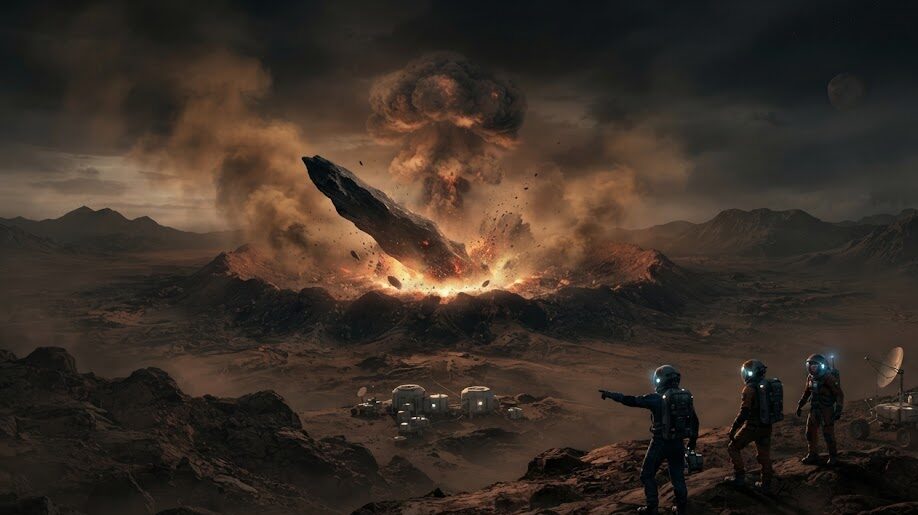
What if an interstellar object of equal or greater size — say, a dense, nickel-iron asteroid measuring one kilometer across, arriving at 85 kilometers per second — scored a direct bullseye collision on the surface of Mars?
Here is the physics of hypervelocity kinetic impact, planetary shockwaves, and the surprising consequences for our own planet Earth.
1. The Kinetic Energy Equation: The Power of Velocity
Kinetic energy is calculated as:
$$E_k = \frac{1}{2} m v^2$$
Notice that velocity is squared. A 1-kilometer iron asteroid striking at 85 km/s carries 16 times more destructive energy than the same asteroid striking at a standard Solar System orbital speed of 20 km/s.
The Teraton Explosion
-
Mass: A 1-kilometer dense metallic interstellar object weighs approximately $4 \times 10^{12}\text{ kilograms}$.
-
Impact Velocity: $85,000\text{ meters per second}$.
-
Kinetic Yield: Roughly $1.44 \times 10^{22}\text{ Joules}$ — equivalent to approximately 3.4 million megatons of TNT (or 70,000 Tsar Bombas detonating simultaneously at a single point).
When it strikes the thin Martian atmosphere, the atmosphere offers zero deceleration. The object strikes the solid silicate rock of Mars in less than a millisecond, penetrating kilometers into the crust before converting its entire kinetic mass into an expanding thermonuclear fireball.
2. The Impact Crater and Global Seismic Shock
The Excavation Phase
Within seconds:
-
A crater 40 kilometers in diameter and 8 kilometers deep is punched into the Martian surface, instantly melting billions of tons of crust into a glowing lake of liquid glass and basalt.
-
A seismic shockwave of magnitude 11.5 tears through the mantle of Mars. Because Mars is smaller and has a rigid, single-plate crust, the seismic wave focuses antipodally on the exact opposite side of the planet, fracturing mountains and triggering chaotic volcanic landslides across Olympus Mons.
3. The Accidental Terraforming: A Temporary Martian Spring
Paradoxically, a violent kinetic strike could briefly resurrect Mars from its frozen grave.
Unleashing Underground Volatiles
The extreme heat of the impact into Mars’s sub-surface cryosphere would:
-
Flash-melt and vaporize hundreds of cubic kilometers of underground ice sheets and permafrost.
-
Liberate gigatons of carbon dioxide gas trapped in carbonate rocks and subsurface clathrates.
-
The atmospheric surface pressure on Mars would jump from its current thin 6 millibars to over 50 to 100 millibars within months.
-
For several decades, a temporary greenhouse effect would allow liquid water rain to fall across equatorial craters, carving temporary rivers across the red sands before the thin atmosphere is slowly stripped away once more by the solar wind.
4. The Earth Connection: The Martian Meteor Barrage
Mars has a low escape velocity of just 5.03 kilometers per second.
Ejecta Crossing Earth’s Orbit
The hypervelocity impact would blast millions of tons of shattered Martian rocks into space at velocities well above Martian escape speed:
-
This debris enters elliptical orbits around the Sun that cross Earth’s path.
-
Over the next 5 to 50 years, Earth would intercept thousands of Martian boulders.
-
Night skies on Earth would experience brilliant, continuous meteor storms, with larger multi-meter fragments detonating as high-altitude airbursts (similar to the 2013 Chelyabinsk meteor) over cities worldwide.
5. Comparative Matrix: Standard Asteroid vs. Interstellar Kinetic Impactor
| Parameter | Standard Asteroid (Solar System) | Interstellar Impactor (‘Oumuamua Class) | Physical Consequence |
|---|---|---|---|
| Origin | Main Asteroid Belt / Kuiper Belt | Deep Interstellar Space (Another Star) | Bound ellipse vs. Hyperbolic trajectory. |
| Typical Impact Speed | 15 to 25 km/s | 70 to 95 km/s | 15x to 20x higher kinetic energy release. |
| Crater Diameter | ~15 to 20 km (1km impacter) | ~35 to 50 km | Deep crustal and mantle penetration. |
| Ejecta Velocity | Mostly sub-orbital (< 5 km/s) | Supra-orbital (> 10 km/s) | Massive interplanetary debris dispersal. |
| Warning Timeline | Decades to centuries (cataloged) | Months to weeks | Virtually impossible to intercept in time. |
Frequently Asked Questions
Could an impact shatter Mars into pieces?
No. To physically shatter Mars into a debris ring, an impactor would need to exceed the gravitational binding energy of Mars ($U \approx 10^{30}\text{ Joules}$). A 1-kilometer object, while devastating to the local crust, lacks the mass to disrupt the planetary core.
Could Martian ejecta bring alien life to Earth?
Yes. In fact, scientists have already found over 300 genuine Martian meteorites on Earth (such as ALH84001) blasted off Mars by ancient impacts. Bacterial spores shielded inside rock fragments can survive millions of years of vacuum and re-entry heat.
6. Relativistic Impact Physics and Atmospheric Inversion
The fluid dynamics of a hypervelocity impact on a thin-atmosphere terrestrial world reveals counter-intuitive shockwave phenomena. When an interstellar kinetic projectile penetrates the Martian lithosphere at 85 km/s, the kinetic energy transfer creates a localized plasma bubble with temperatures exceeding 100,000 Kelvin.
The Thermal Vapor Cloud and Hydrodynamic Plumes
-
The Fireball Expansion: The vaporized iron projectile and target bedrock expand upward into the vacuum at velocities exceeding 25 km/s, punching a massive hole through the Martian atmosphere.
-
Global Dust Stratification: Silicate nanoparticles settle into the upper atmosphere, reflecting sunlight and cooling the surface, followed months later by greenhouse warming from vaporized subsurface ice.
-
Orbital Perturbations: While the mass of a 1-kilometer asteroid is tiny compared to Mars ($6.4 \times 10^{23}\text{ kg}$), the extreme kinetic momentum imparts a minute, measurable torque, subtly shifting the perihelion precession of the Red Planet.
WhatIfLab Speculative Science Monograph #17. Hypervelocity hydrocode shock modeling, Pi-group crater scaling, and interplanetary lithopanspermia transfer dynamics.