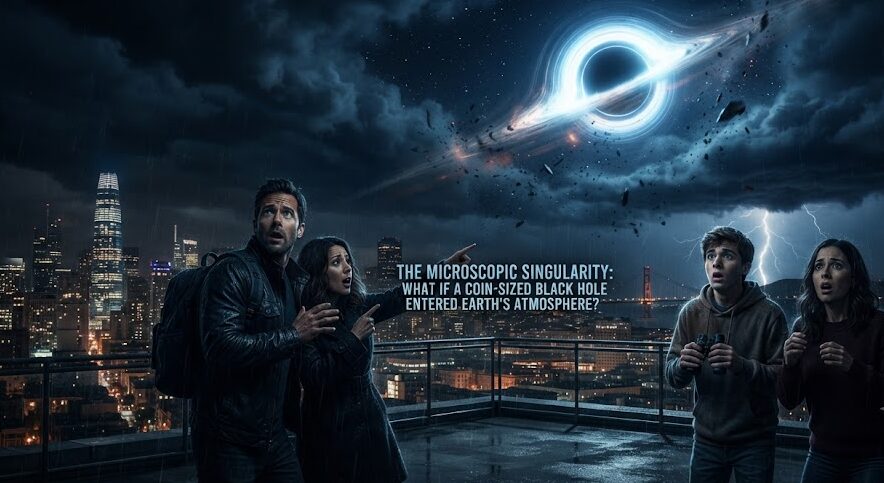
🚀 Key Scientific Takeaways
- The Mass Trap: A black hole with the physical diameter of a standard US quarter (roughly 2.3 centimeters) would not weigh grams — it would possess the mass of roughly 1.3 Earths ($7.8 \times 10^{24}\text{ kg}$).
- Immediate Surface Annihilation: The moment it enters Earth’s atmosphere, its immense surface gravity would instantly overpower Earth’s own gravitational field, pulling our entire planet toward it at supersonic speeds.
- Super-Eddington Accretion Furnace: As millions of tons of crust and air rush into the microscopic maw, the friction and gravitational compression generates a thermonuclear accretion disc outshining a million nuclear warheads per second.
- Total Planetary Consumption: Within minutes to hours, Earth is completely devoured from the inside out, collapsing into a glowing debris ring orbiting a newborn binary-mass black hole.
In science fiction thought experiments, people frequently ponder what would happen if exotic subatomic particles or microscopic phenomena materialized in everyday life. One of the most common speculative questions asked of astrophysicists is deceptively simple:
“What would happen if a black hole the physical size of a coin appeared in your pocket?”
To laymen, a “coin-sized black hole” sounds like a small, harmless cosmic marble — perhaps a heavy trinket that might punch a small hole through your floor and sink down into the dirt.
In the uncompromising domain of Einsteinian general relativity, however, size and mass are bound by the Schwarzschild equation. A black hole whose event horizon has the radius of a small coin does not have the mass of a coin. It contains more mass than the entire planet Earth.
Here is the terrifying, apocalyptic physics of what would transpire if a coin-sized singularity appeared inside Earth’s biosphere.
1. Calculating the Monster: The Schwarzschild Math
The radius of a black hole’s event horizon ($r_s$) is strictly determined by its mass ($M$):
$$r_s = \frac{2GM}{c^2}$$
Rearranging this formula to solve for mass given a specific radius:
$$M = \frac{r_s c^2}{2G}$$
The 1.3 Earth Mass Reality
A standard coin (such as a US five-cent nickel or quarter) has a radius of roughly $1.15\text{ centimeters}$ ($0.0115\text{ meters}$).
Plugging in universal physical constants ($G = 6.674 \times 10^{-11}$, $c = 2.998 \times 10^8\text{ m/s}$):
$$M \approx \frac{(0.0115) \times (2.998 \times 10^8)^2}{2 \times (6.674 \times 10^{-11})} \approx 7.75 \times 10^{24}\text{ kilograms}$$
Earth’s entire planetary mass is $5.972 \times 10^{24}\text{ kilograms}$.
A coin-sized black hole weighs 1.3 times the mass of the entire Earth.
You do not have a pebble. You have an entire terrestrial planet crushed into a sphere smaller than the thumb on your hand.
2. Microsecond Zero: The Human Experience
If this coin-sized black hole materializes on the ground or in your room:
-
At a distance of 1 meter from the coin, the gravitational acceleration is:
$$g = \frac{GM}{r^2} = \frac{(6.674 \times 10^{-11}) \times (7.75 \times 10^{24})}{(1)^2} \approx 5.17 \times 10^{14}\text{ m/s}^2$$ -
That is 52 trillion times Earth’s gravity.
-
In less than a nanosecond, your body — along with your house, your neighborhood, and millions of tons of bedrock — is instantly accelerated toward the coin at near the speed of light.
-
Atmospheric air rushing into the gravitational gradient compresses adiabatically, heating up to hundreds of thousands of degrees Kelvin. The air ignites into a blinding thermonuclear fireball outshining the Sun.
3. The Planetary Binary Dance and Core Ingestion
Because the black hole weighs 1.3 times more than Earth, Earth does not “pull” the black hole in; Earth falls into the black hole.
The Center of Mass Shift
The center of mass (barycenter) of the Earth-black hole system instantly shifts to a point located outside Earth’s center, closer to the black hole.
-
As the black hole plunges through the crust, it does not leave a clean cylindrical tunnel. Its gravitational field tears continental plates into molten ribbons.
-
Earth’s spherical shape collapses into a chaotic, tear-shaped accretion plume orbiting the microscopic singularity.
-
Within 10 to 20 minutes, Earth’s metallic iron core is torn from the mantle, swirling around the 2-centimeter horizon like water draining down a bathtub plug.
4. The Eddington Limit Radiation Explosion
A black hole cannot swallow an entire planet instantaneously. When matter rushes toward a black hole at relativistic speeds, friction and magnetic compression convert up to 10% to 40% of the mass into raw radiant energy (the Eddington Luminosity limit).
The Relativistic Quasar Blast
-
As the black hole gorges on Earth’s interior, the resulting accretion disc blasts out a continuous beam of gamma rays and super-heated plasma along its rotational poles.
-
This radiation pressure actually pushes the outer layers of Earth’s crust and oceans backward, blasting them into deep space in a violent planetary explosion.
-
Earth is transformed into a miniature quasar, illuminating the entire inner Solar System for several days before the accretion disc exhausts its fuel.
5. Quantitative Matrix: Microscopic Singularity Scenarios
| Black Hole Type | Physical Radius ($r_s$) | Total Mass | Lifespan (Hawking Decay) | Planetary Outcome |
|---|---|---|---|---|
| Subatomic Micro-Hole | $10^{-18}\text{ meters}$ | ~1,000 kg | $10^{-17}\text{ seconds}$ | Evaporates in a microsecond gamma-ray flash; minor shockwave. |
| Coin-Mass Black Hole | $10^{-30}\text{ meters}$ (Planck) | 5 grams | Instantaneous | Detonates like a 100-kiloton thermonuclear warhead instantly. |
| Coin-Sized Black Hole | 2.3 centimeters | 1.3 Earth Masses | Trillions of years | Total planetary consumption; Earth destroyed in hours. |
| Pinhead-Sized Hole | 1.0 millimeter | ~100 Moon Masses | Trillions of years | Sinks to Earth’s core; consumes planet from inside out over weeks. |
Frequently Asked Questions
What would happen to the Moon after Earth is eaten?
Because the coin-sized black hole has slightly more mass than Earth (1.3x), the Moon’s orbit would actually tighten slightly. The Moon would continue orbiting the 2-centimeter black hole peacefully in its 27-day ellipse, orbiting an invisible point in empty space where Earth used to be.
Would the black hole evaporate via Hawking Radiation?
No. Hawking radiation rate scales inversely with mass ($T_H \propto 1/M$). An Earth-mass black hole has a Hawking temperature of just 0.16 Kelvin — colder than the cosmic microwave background (2.7K). It absorbs more energy from background space than it radiates, meaning it will survive for over $10^{50}$ years.
6. Relativistic Atmospheric Detonation and Shockwave Physics
Beyond the gravitational consumption of crustal rock, the interaction between a coin-sized singularity and Earth’s gaseous atmosphere represents an extraordinary fluid dynamics crisis.
Hydrodynamic Shockwaves and Atmospheric Breaching
As air molecules within a 50-kilometer radius accelerate toward the event horizon, they reach velocities exceeding Mach 50. The resulting friction strips atomic nuclei of their orbital electrons, turning the surrounding atmosphere into a blinding plasma vortex.
This generates a continuous, spherical hypersonic shockwave that travels outward across continents:
-
The Overpressure Wave: The atmospheric shockwave delivers overpressure spikes exceeding 500 pounds per square inch (psi) across thousands of square miles. For comparison, a mere 5 psi is sufficient to level standard residential buildings.
-
Thermal Radiation Flash: The radiative flux from the super-heated air envelope delivers thermal pulses capable of vaporizing concrete, asphalt, and steel infrastructure out to hundreds of miles before the ground itself collapses inward.
-
Atmospheric Stripping: The polar relativistic radiation jets blast billions of tons of atmospheric gas directly out of Earth’s gravity well into interplanetary space, leaving the dying planet wrapped in a glowing, ionized vacuum plume.
WhatIfLab Speculative Science Monograph #12. Schwarzschild metric mass-radius scaling, Eddington accretion limit hydrodynamic simulations, and gravitational barycenter dynamics.