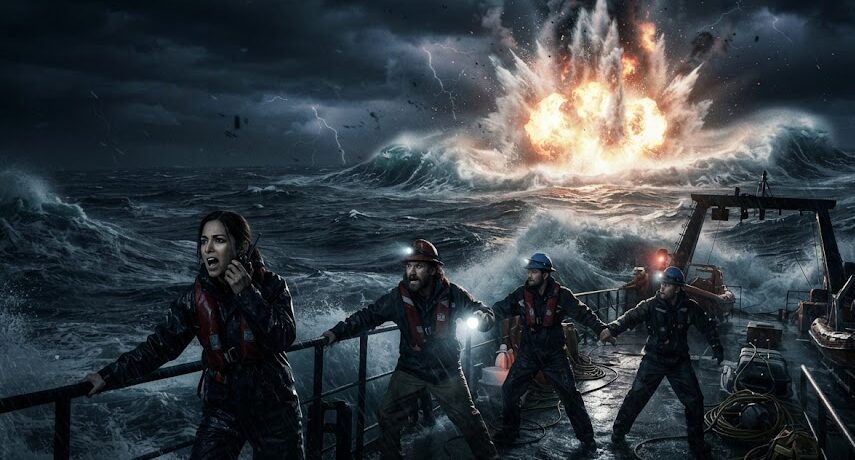
🚀 Key Scientific Takeaways
- The Apophis Reality: Asteroid 99942 Apophis (roughly 370 to 450 meters wide) will make a historically close flyby within 31,600 kilometers of Earth on Friday, April 13, 2029 — passing below geostationary satellites.
- Kinetic Yield of Ocean Strike: A 500-meter stony-iron asteroid striking the deep ocean at 12.6 km/s releases roughly $1,200\text{ megatons of TNT}$ — nearly 80,000 times the energy of the Hiroshima atomic bomb.
- The Transient Cavity & Mega-Tsunamis: The impact blasts a transient water crater 10 kilometers wide and punches straight through 4 kilometers of ocean depth into the seafloor, generating initial tsunami waves over 100 meters high.
- Stratospheric Oceanic Vapor Injection: Billions of tons of seawater and marine halogens (chlorine and bromine) are injected directly into the stratosphere, inducing rapid ozone destruction and global climatic cooling.
In December 2004, astronomical observatories around the globe sent shockwaves through the scientific community. A newly discovered Near-Earth Asteroid (NEA), cataloged as 99942 Apophis — named after the ancient Egyptian serpent demon of darkness and chaos — registered an unprecedented Level 4 on the Torino Impact Hazard Scale. Initial orbital calculations suggested an alarming 2.7% probability of a direct collision with Earth in April 2029.
Subsequent high-precision radar observations by Goldstone and Arecibo have fortunately ruled out an impact for 2029 and 2036. However, on April 13, 2029, Apophis will still skim past Earth at a heart-stopping distance of just 31,600 kilometers (19,600 miles) — closer than our geostationary television and weather satellites — visible to the naked eye for over two billion people across Europe, Africa, and Asia.
In planetary defense physics, Apophis represents the archetype of a “city-killer” and “region-destroyer”: an object between 350 and 500 meters in diameter.
What if orbital keyholes aligned catastrophically, and an asteroid of Apophis’s caliber struck the deep abyssal waters of the central Pacific Ocean?
1. The Atmospheric Entry: The 10-Second Thunderbolt
Apophis strikes Earth’s atmosphere at a velocity of 12.6 kilometers per second (roughly 45,000 km/h or 28,000 mph) at an angle of 45 degrees.
The Ram Pressure Descent
-
No Atmospheric Shielding: A 500-meter silicate-iron asteroid weighs roughly $1.3 \times 10^{11}\text{ kilograms}$ (130 million tons). Earth’s atmosphere is completely incapable of slowing it down; it slices from the vacuum of space down to sea level in less than 8 seconds.
-
The Hypersonic Ionization Column: As the rock compresses the air in front of it, temperatures exceed 20,000 Kelvin. The fireball is hundreds of times brighter than the Sun, instantly blinding any human observer within 300 kilometers.
-
Impact Yield: The kinetic energy converted at the water surface equals roughly $5.0 \times 10^{18}\text{ Joules}$ — equivalent to 1,200 megatons of TNT.
2. The Oceanic Cavity and the Mega-Tsunami Genesis
Water is fundamentally incompressible compared to air. When 130 million tons of iron and stone hit the ocean surface:
The Transient Water Cavity
-
The 10-Kilometer Void: The kinetic energy violently displaces the ocean, carving a transient crater of empty space 10 kilometers wide and 4 kilometers deep, briefly exposing the volcanic basalt of the ocean floor.
-
The Seafloor Strike: The remnant core of the asteroid smashes into the seabed, excavating an underwater impact crater in the tectonic crust and triggering a magnitude 8.0 submarine earthquake.
-
The Water Column Collapse: Seconds later, hundreds of millions of tons of displaced seawater collapse back into the void from all directions. The colliding water columns shoot upward into the stratosphere as a colossal vertical geyser reaching 20 kilometers into the sky.
3. The Propagation of the Pacific Tsunami
The outward collapse of the water column generates concentric tsunami wave trains traveling across the deep ocean at jet airliner speeds (800 to 900 km/h).
The Coastal Shoaling Catastrophe
In deep water (4,000 meters), the tsunami waves measure only 5 to 10 meters high, barely noticeable to passing container ships. But as they approach continental shelves, the physics of wave shoaling compresses their speed and amplifies their height:
-
Hawaii (1 Hour Post-Impact): Waves surging to heights of 60 to 100 meters (200 to 330 feet) completely submerge Honolulu, wiping out coastal infrastructure and leaving only volcanic highlands intact.
-
The West Coast of North America (4 to 5 Hours Post-Impact): Los Angeles, San Francisco, and Seattle face continuous walls of water 20 to 35 meters high, penetrating miles inland.
-
Japan and East Asia (6 to 8 Hours Post-Impact): Tokyo, Shanghai, and Sydney suffer catastrophic inundation, with coastal sea-walls built for standard earthquakes completely overwhelmed.
4. Comparative Matrix: Land Strike vs. Ocean Strike (500m Asteroid)
| Impact Parameter | Continental Land Strike | Deep Ocean Strike (Pacific) | Civilizational Result |
|---|---|---|---|
| Primary Destruction | Blast wave, fireball, molten ejecta | Mega-tsunami wave trains | Pacific Rim maritime infrastructure wiped out. |
| Crater Morphology | Classic 8-10 km impact crater | 10 km transient water crater; seabed scar | Submarine landslides and underwater tremors. |
| Atmospheric Injection | Silicate dust and soot (Nuclear winter) | Seawater vapor and sea salt halogens | Rapid stratospheric ozone destruction. |
| Fatality Radius | Local/Regional (100 to 300 km) | Basin-Wide (Pacific Coastlines) | Multi-million coastal casualties without evacuation. |
| Economic Loss | Trillions (Regional) | $10+ Trillion (Global Port Destruction) | Global shipping and supply chains halted for years. |
Frequently Asked Questions
Could Apophis destroy human civilization completely?
No. Apophis is roughly 370 meters in diameter — not the 10-kilometer monster that wiped out the dinosaurs. It is a regional cataclysm that would devastate several nations or a major oceanic basin, but humanity as a global species would easily survive.
Can modern planetary defense deflect a 500-meter asteroid?
Yes! In 2022, NASA’s DART mission successfully proved the kinetic impactor technique by deflecting the asteroid Dimorphos. With 5 to 10 years of advance warning, a fleet of kinetic impactors or a gravity tractor could easily alter Apophis’s trajectory by the millimeters per second needed to completely miss Earth.
6. The Multi-Decadal Marine Ecosystem and Climate Disruption
The impact of a 500-meter asteroid into deep ocean waters does not end when the tsunami waves recede from charred shorelines. The global climate and oceanic food webs sustain multi-decadal aftershocks.
Oceanic Inversion and Toxic Algal Blooms
-
Abyssal Nutrient Upwelling: The violent excavation of 4 kilometers of water column drives deep, ancient benthic nutrients (phosphates, nitrates, and toxic heavy metals) to the surface.
-
Super-Eutrophication: Massive, toxic red tides and harmful dinoflagellate blooms spread across thousands of square miles of the Pacific, de-oxygenating the upper photic zone and causing widespread asphyxiation of pelagic tuna, salmon, and marine mammal populations.
-
Acid Rain Showers: Nitric acid generated by the atmospheric shockwave dissolves into cloud droplets, precipitating down as highly acidic rain across the Pacific Rim, stunting terrestrial crop yields and acidifying coastal estuaries.
WhatIfLab Speculative Science Monograph #20. Hydrocode ocean cavity simulations, shallow-water wave shoaling equations, and stratospheric marine halogen ozone depletion models.