🚀 Key Scientific Takeaways
- The Roche Limit Creation: Planetary rings form when a moon or icy comet ventures inside a planet’s Roche limit (approximately 10,000 to 18,000 km from Earth’s center), where tidal gravity rips the body into billions of glittering icy fragments.
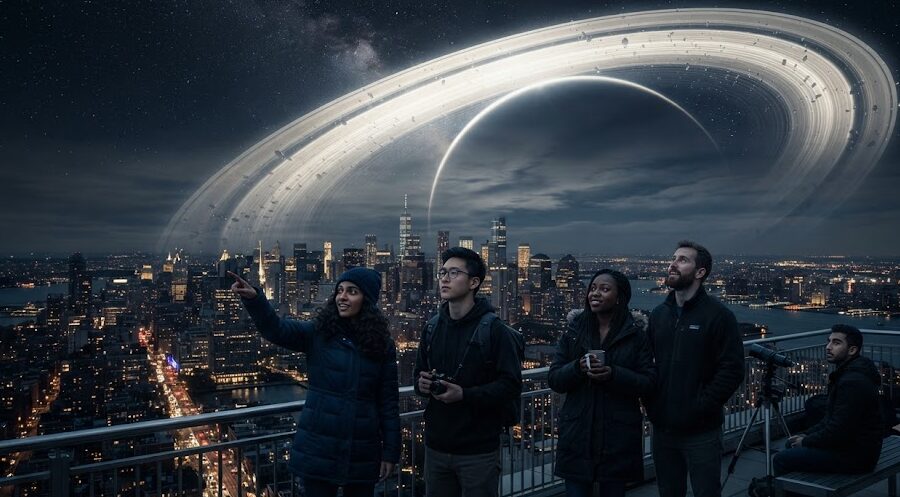
- Sky Perspectives: From the equator, the rings appear as a razor-thin, brilliant beam of light slicing directly through the zenith. From mid-latitudes (Paris, New York, Tokyo), the rings arch majestically across the southern sky like an iridescent cosmic rainbow.
- The Ring Shadow Climate Trap: The rings cast a colossal permanent shadow across Earth’s temperate winter hemisphere, blocking incoming solar irradiance and triggering intense, hyper-glaciated continental winters.
- The Death of Satellite Orbits: A dense ring system acts as a kinetic minefield. Modern low Earth orbit satellites, GPS constellations, and space stations would be pulverized by millimeter-sized ring particles, making space exploration vastly more challenging.
Among the wonders of the Solar System, nothing captivates the human imagination quite like the majestic ring system of Saturn. Stretching over 280,000 kilometers wide yet measuring a mere 10 to 100 meters thick, Saturn’s rings are composed of trillions of water-ice boulders, crystalline snowballs, and silicate dust particles orbiting in delicate, synchronized resonance.
Planetary scientists now know that rings are not permanent fixtures; they are dynamic, temporary structures. In fact, 4.5 billion years ago, when the protoplanet Theia collided with the early Earth, our planet was briefly encircled by a colossal ring of vaporized rock and magma debris before that material coalesced to form our Moon.
What if that ring had not condensed into a single satellite? What if Earth had retained a permanent, massive, reflective ring system of pure water-ice and silicates throughout human history?
How would our night sky look from different latitudes? How would the colossal shadows cast by the rings reshape planetary climate, agriculture, mythology, and modern space exploration?
1. The View From the Ground: Shifting Latitudinal Skylines
Because planetary rings naturally align themselves along a planet’s rotational equator due to gravitational oblateness ($J_2$ perturbation), the appearance of Earth’s rings would depend entirely on your geographic latitude.
At the Equator (Quito, Nairobi, Singapore)
Standing directly on the equator:
-
You sit in the exact plane of the rings.
-
The rings do not look wide. Instead, they appear as a blindingly bright, razor-thin ribbon of silver light emerging from the eastern horizon, slicing straight overhead through the zenith, and plunging into the western horizon.
-
During the day, it looks like an ethereal white laser drawn across the blue sky; at night, it glows with dazzling brilliance, casting crisp shadows on the ground below.
At Mid-Latitudes (New York, London, Tokyo, Sydney)
Moving to 40° North or South:
-
The perspective opens up. The rings arch gracefully across the southern horizon (in the Northern Hemisphere) like a colossal celestial bridge.
-
You can clearly observe distinct concentric divisions — analogous to the Cassini Division on Saturn — where shepherd moonlets have carved empty lanes through the ice.
-
The night sky is never truly dark: the reflective albedo of pure ice rings reflects sunlight onto the night side, providing illumination equivalent to dozens of full moons combined.
2. Climate Chaos: The Great Ring Shadow
While the visual splendor would inspire poets and artists, the thermodynamic consequence of a ring system is severe: the rings cast a colossal shadow.
The Deep Winter Freeze
Because Earth is tilted on its axis at 23.5 degrees:
-
During winter in the Northern Hemisphere, the Sun sits south of the equator. The rings block incoming sunlight, casting a dark, defined shadow hundreds of miles wide across North America, Europe, and Asia.
-
In the path of the ring shadow, daytime temperatures plummet by 10°C to 20°C. Winter becomes significantly colder, harsher, and longer, with blizzards persisting for months under the semi-eclipsed Sun.
-
Conversely, during summer, the rings reflect additional sunlight onto the polar regions, accelerating summer glacial melting and creating extreme seasonal thermal whiplashes.
3. The Satellite Crisis: The Impassable Orbital Barrier
For modern human technology, a ring system would represent an engineering nightmare.
Kessler Syndrome on a Planetary Scale
The rings would occupy the most coveted orbital zones around Earth — from 10,000 kilometers out to 30,000 kilometers:
-
Trillions of centimeter-sized icy and rocky particles traveling at 8 kilometers per second would act as a permanent, impenetrable kinetic minefield.
-
Geostationary satellites, GPS constellations, and polar-orbiting weather probes would be shredded by high-velocity impacts within hours of deployment.
-
Space exploration would be severely restricted: rockets could only launch from extreme high-latitude sites (such as Norway or Antarctica), firing upward through polar trajectories to bypass the equatorial ring plane entirely.
4. Comparative Matrix: Moon-Only Earth vs. Ringed Earth
| Environmental Factor | Current Earth (Moon Only) | Ringed Earth (Saturn-Class Rings) | Impact on Civilization |
|---|---|---|---|
| Nocturnal Light Levels | 0.001 to 0.3 lux (Lunar Phases) | 1.0 to 5.0 lux (Perpetual Glow) | True night darkness practically eliminated in mid-latitudes. |
| Winter Solar Insolation | Standard seasonal curve | Significantly blocked by ring shadow | Extreme, sub-zero continental winters in shadow zones. |
| Astronomy & Telescopes | Dark skies viable globally | Severe light pollution from ring albedo | Optical astronomy forced to far polar observatories. |
| Spaceflight Viability | Unrestricted launch azimuths | Equatorial launches strictly fatal | Rocket launches restricted to polar inclination corridors. |
| Avian Navigation | Stellar & geomagnetic cues | Dominated by glowing ring arc cues | Migratory species calibrate north-south flight via the ring arch. |
Frequently Asked Questions
Could Earth’s rings ever fall down to the surface?
Yes. Planetary rings slowly decay over hundreds of millions of years. Atmospheric drag from Earth’s exosphere and solar radiation pressure would cause inner ring particles to spiral downward, creating a continuous “ring rain” of harmless, glowing meteors burning up in the upper atmosphere.
Could humanity build rings around Earth artificially?
Theoretically, yes. Future civilizations could pulverize a captured small asteroid (such as a 100-meter carbonaceous asteroid) in low Earth orbit to deliberately create a thin artificial dust ring designed to shade equatorial regions and combat global warming.
6. Mythological, Cultural, and Psychological Evolution
How would human consciousness and mythology develop under a sky dominated by a colossal, glowing ring?
The Bridge of the Gods
In human antiquity, the rings would not be seen as a collection of icy rocks, but as the literal pathway of the deities:
-
Equatorial Civilizations: Early peoples in Central Africa and South America would worship the razor-thin silver beam at the zenith as the “Spine of Heaven” or the divine thread holding the cosmos together.
-
Mid-Latitude Religions: In Europe and Asia, the great glowing southern arch would serve as the foundational architecture of mythologies, representing a celestial serpent, an ivory bridge, or the boundary between mortal realms and the heavens.
-
Navigation without Magnetic Compasses: Ancient seafaring civilizations would not require Polaris to find north; measuring the angle and inclination of the ring arch would provide pinpoint geographical latitude coordinates anywhere on Earth’s oceans.
WhatIfLab Speculative Science Monograph #18. Roche limit tidal fragmentation, J2 quadrupole oblateness gravitational harmonics, and seasonal ring-shadow insolation models.