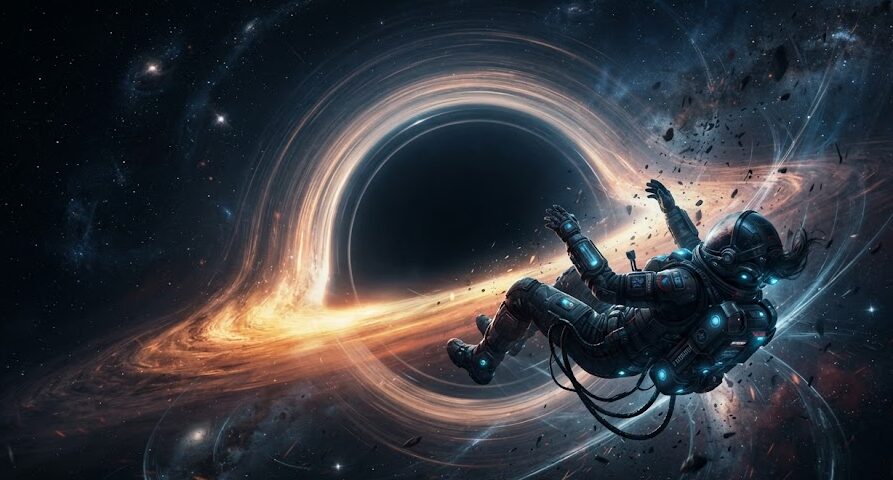
🚀 Key Scientific Takeaways
- The Tidal Gradient Paradox: In small stellar-mass black holes, tidal forces tear matter apart (spaghettification) millions of kilometers before reaching the horizon. In a supermassive black hole of billions of solar masses, the tidal forces at the event horizon are so gentle that an astronaut would cross completely unharmed.
- The Asymmetric Reality: To an outside observer watching through a telescope, the falling astronaut appears to slow down, freeze permanently at the horizon, and red-shift into invisibility. To the falling astronaut, however, the crossing occurs in a normal, finite heartbeat.
- Extreme Relativistic Blueshift: Looking backward out into the universe, the astronaut watches the entire future history of the cosmos unfold in accelerated fast-forward, with distant starlight compressed into a concentrated, high-energy optical ring.
- The Reversal of Space and Time: Once inside the Schwarzschild radius, the radial coordinate becomes timelike: moving toward the central singularity is as physically inevitable as moving forward into tomorrow.
Of all the theoretical constructs predicted by Albert Einstein’s General Theory of Relativity, none challenge human comprehension more profoundly than black holes. They are regions of spacetime where mass is crushed to infinite density — a mathematical singularity — surrounded by a boundary of no return known as the event horizon.
In popular culture, black holes are depicted as monstrous cosmic vacuum cleaners that instantly shred, stretch, and obliterate anything that comes near them. For stellar-mass black holes (weighing 5 to 30 times our Sun), this gruesome fate — known in astrophysics as spaghettification — is literal physical fact: the difference in gravitational pull between your feet and your head would rip your cellular structure into a stream of subatomic spaghetti.
However, the mathematics of the Schwarzschild metric reveal a mind-bending counter-intuitive truth: the larger a black hole is, the weaker its tidal forces at the event horizon become.
If you fell into a supermassive black hole — such as TON 618 (weighing 66 billion Suns) or the giant at the center of the galaxy M87 — you would glide smoothly across the point of no return without feeling a single bump.
What would an astronaut actually see, feel, and experience as they drifted past the threshold of eternity? Here is the relativistic journey into the abyss.
1. The Physics of Spaghettification: Why Size Matters
Tidal acceleration across a human body of height $\Delta r$ in a gravitational field is given by:
$$a_{\text{tidal}} \approx \frac{2 G M \Delta r}{r^3}$$
Notice the denominator: tidal force scales inversely with the cube of the distance ($r^3$).
Stellar Black Hole vs. Supermassive Behemoth
-
Stellar Black Hole (10 Solar Masses): The event horizon radius ($r_s = 2GM/c^2$) is tiny — only 30 kilometers. At this small distance, the tidal differential between your head and feet is thousands of times greater than Earth’s gravity. You are violently torn into atomic filaments long before reaching the boundary.
-
Supermassive Black Hole (4 Billion Solar Masses): The Schwarzschild radius expands to over 12 billion kilometers (larger than our entire Solar System). Because the boundary is so far from the center, the tidal gradient across a 2-meter human body is less than $10^{-6}\text{ g}$ — gentler than the breeze of an indoor air conditioner. You would float across the event horizon in utter physical comfort.
2. The Observer Paradox: Freezing vs. Falling
General relativity creates two completely irreconcilable perspectives between the person falling in and their crewmates watching safely from an orbital mother-ship.
The External View: The Frozen Red Phantom
To your colleagues watching from outside:
-
As you approach the horizon, gravitational time dilation stretches your time coordinates relative to theirs: $t_{\text{obs}} = \tau / \sqrt{1 – r_s/r}$.
-
Your movements appear to slow down. Your watch ticks slower and slower.
-
Light photons emitted from your spacesuit lose energy climbing out of the gravitational well, shifting from visible light into deep red, infrared, microwave, and finally radio frequencies.
-
From the outside perspective, you never actually cross the horizon. You appear to freeze forever at the boundary, fading away into an infinitely dim, red silhouette.
Your Internal View: The Silent Crossing
From your own proper reference frame (proper time $\tau$):
-
Your wristwatch ticks at normal speed. Your heart beats at 75 beats per minute.
-
There is no physical fence, no painted barrier, no wall of fire.
-
The moment you cross the Schwarzschild radius ($r = r_s$), nothing feels different. You have crossed the ultimate cosmic boundary, yet local physics remains completely unchanged (the Equivalence Principle).
3. The Optical Horizon: Watching the End of the Universe
What do your eyes see as you look around?
The Einstein Ring Compression
Looking back out toward the universe you left behind:
-
Gravitational lensing bends light from the entire sky into a narrowing circular portal directly above your head.
-
The entire 360-degree cosmos — stars, galaxies, supernovae — is compressed into a glowing, kaleidoscopic halo.
-
Because you are falling at relativistic velocity, incoming light is intensely Doppler-blueshifted and time-accelerated. You see centuries of cosmic evolution pass in minutes, watching stars ignite, burn out, and galaxies collide in hyper-speed fast-forward.
The Black Sphere Swallows the Sky
Looking downward:
- The blackness of the event horizon does not remain beneath you. It rises up like a colossal black bowl, wrapping around your field of vision until the darkness envelops your entire visual sphere, leaving only the tiny pinprick of the outside universe above.
4. Inside the Horizon: Where Space Becomes Time
Once inside the event horizon, the metric tensor of spacetime undergoes a mathematical inversion that defies everyday human intuition.
The Inevitability of the Singularity
Outside the black hole, space is a direction you can choose: you can walk forward, backward, left, or right, but time is an irreversible vector pulling you toward the future.
Inside the event horizon:
-
The radial direction ($r$) becomes timelike.
-
The central singularity is no longer a “place” in space that you could steer around with rocket thrusters. It is a moment in your future.
-
Firing your spaceship’s engines inside the event horizon will not slow your descent; in fact, accelerating increases your proper energy, causing you to reach the singularity faster.
-
For a supermassive black hole, you have approximately several hours to several days of proper time inside the horizon before encountering the true gravitational singularity.
5. Comparative Matrix: Falling Into Different Black Holes
| Black Hole Type | Mass Range | Horizon Radius ($r_s$) | Tidal Forces at Horizon | Astronaut Survival Outcome |
|---|---|---|---|---|
| Microscopic / Primordial | Asteroid mass ($10^{12}\text{ kg}$) | Subatomic ($< 10^{-15}\text{ m}$) | Infinite | Instant quantum evaporation / explosive micro-burst. |
| Stellar-Mass Black Hole | 10 Solar Masses ($10\text{ }M_{\odot}$) | ~30 km | Fatal ($> 10^5\text{ g}$) | Violent spaghettification thousands of km before horizon. |
| Intermediate-Mass | 1,000 to 10,000 $M_{\odot}$ | ~3,000 to 30,000 km | Severe (Fatal) | Severe crushing and structural disintegration at boundary. |
| Supermassive (Sagittarius A*) | 4.3 Million $M_{\odot}$ | ~12.7 Million km | Tolerable (~1 g) | Survives crossing intact; dies hours later near core. |
| Hyper-Massive (TON 618) | 66 Billion $M_{\odot}$ | ~195 Billion km | Near Zero ($< 10^{-6}\text{ g}$) | Completely imperceptible crossing; survives days inside. |
Frequently Asked Questions
Could you send a radio signal back to Earth from inside the horizon?
No. Radio waves travel at the speed of light. Inside the event horizon, even light rays emitted directly outward are dragged backward toward the central singularity by the inward waterfall of spacetime. No information can ever escape to the outside universe.
What actually happens at the central singularity?
General relativity predicts infinite density and curvature, where the laws of classical physics break down completely. Physicists believe that at the Planck scale ($10^{-35}\text{ meters}$), quantum gravity takes over, potentially revealing an exotic string-theory structure, a quantum fuzzball, or a gateway to a newborn baby universe.
WhatIfLab Speculative Science Monograph #11. Schwarzschild and Kerr metric tensors, relativistic gravitational blueshift models, and geodesic tidal acceleration equations.