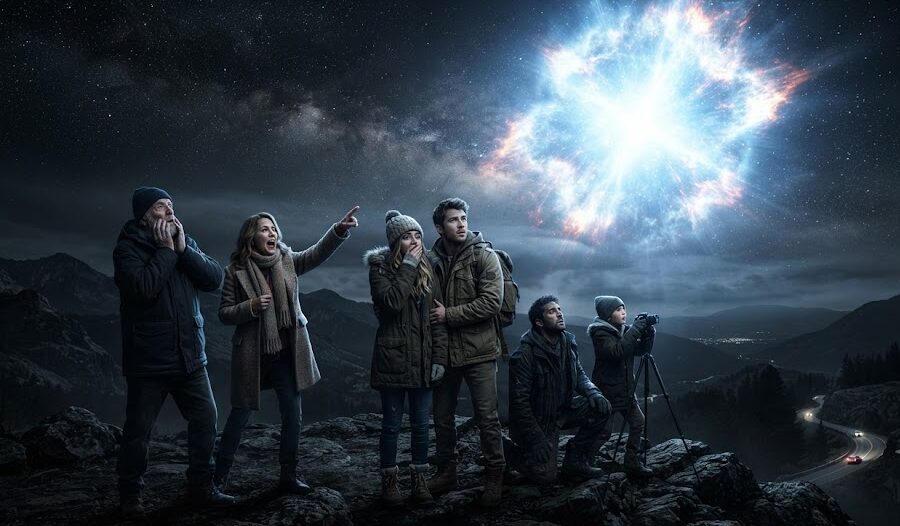
🚀 Key Scientific Takeaways
- The Kill Zone Radius: Planetary astrophysics establishes a “lethal zone” of approximately 30 light-years (10 parsecs). A Type II core-collapse supernova within this radius delivers sufficient ionizing radiation to trigger a mass extinction.
- Optical Splendor: The exploding star would shine brighter than the full moon, casting sharp shadows at night and remaining visible to the naked eye in broad daylight for several continuous months.
- Ozone Depletion Catastrophe: Prompt gamma-rays and X-rays dissociate stratospheric nitrogen and oxygen into nitric oxides ($NO_x$), destroying up to 90% of Earth’s protective ozone layer for a decade.
- The Relativistic Cosmic Ray Wave: Decades after the light flash, the supernova blast wave arrives: a crushing barrage of relativistic cosmic ray iron nuclei, inducing radioactive showers, mutations, and deep marine extinction.
Supernovae are the most violent catastrophic events in the known universe. When a supermassive star — at least eight times the mass of our Sun — exhausts its nuclear fuel, its iron core collapses under immense gravity in less than a second.
The resulting rebound blast wave releases more energy in a matter of seconds than our Sun will emit across its entire 10-billion-year lifespan ($10^{44}\text{ Joules}$). For weeks, a single dying star can outshine an entire galaxy of 200 billion stars combined.
In our cosmic neighborhood, the red supergiant Betelgeuse in the constellation Orion is doomed to explode in a spectacular supernova. Fortunately for humanity, Betelgeuse sits at a comfortable safety distance of roughly 640 light-years away. When it explodes, it will provide an astonishing optical fireworks show in our night sky for months, but its ionizing radiation will be safely diluted by distance.
What if, however, a massive star exploded inside the astronomical “Kill Zone” — just 30 light-years (approximately 9.2 parsecs) from Earth?
From the blinding optical flash to the silent, invisible death of our ozone shield, here is the chronological physics of a near-Earth supernova strike.
1. The Optical Arrival: Night Becomes Day
Light travels 30 light-years in precisely 30 years. When the photons from the core-collapse finally reach Earth:
The New Second Sun
-
Blinding Daylight Flash: In an instant, a brilliant, piercing pinprick of electric blue-white light ignites in the sky. Within hours, its apparent magnitude reaches -12 to -14 — outshining the full moon by several factors.
-
Cast Shadows at Midnight: For six to twelve months, true darkness ceases on the side of Earth facing the supernova. The explosion casts sharp, crystalline shadows across mountains, cities, and oceans at midnight. It remains strikingly visible even at high noon against the glare of the Sun.
-
No Shockwave Yet: The blast itself — consisting of physical stellar debris moving at 10,000 km/s — lags thousands of years behind the speed-of-light photons. The initial danger arrives purely as invisible electromagnetic radiation.
2. Atmospheric Chemistry: The Destruction of the Ozone Shield
The fatal blow to terrestrial biology is not heat; it is stratospheric chemistry.
The Catalytic Nitrogen Oxide Chain
A supernova at 30 light-years bathes Earth’s upper atmosphere in an intense pulse of hard X-rays and gamma rays over several months:
-
These ionizing rays split molecular nitrogen ($N_2$) and oxygen ($O_2$) into reactive radicals.
-
These radicals recombine to form nitrogen oxides ($NO$ and $NO_2$).
-
Nitrogen oxides act as relentless catalytic destroyers of ozone ($O_3$):
$$NO + O_3 \rightarrow NO_2 + O_2$$
$$NO_2 + O \rightarrow NO + O_2$$
Within two years of the blast, 70% to 90% of Earth’s global ozone layer is obliterated.
The Brown Smog and Solar UV-B Torrent
As ozone vanishes:
-
The nitrogen dioxide gas forms a permanent, reddish-brown atmospheric smog encircling the globe, absorbing blue light and dimming normal sunlight.
-
Lethal solar ultraviolet radiation (UV-B and UV-C) penetrates completely unhindered down to sea level.
-
Stepping outside in direct sunlight for more than 10 minutes would cause severe third-degree solar burns in humans and irreversible blindness in wildlife.
3. The Biosphere Collapse: From Plankton to Megafauna
The Sterilization of the Upper Oceans
The most vulnerable organisms on Earth are phytoplankton floating in the upper 2 meters of the world’s oceans. Phytoplankton generate over 50% of the oxygen we breathe and form the absolute foundational base of the marine food web.
-
The unshielded solar UV-B barrage destroys phytoplankton cellular DNA within weeks.
-
Without phytoplankton, zooplankton starve, triggering the rapid mass extinction of krill, fish stocks, squid, and marine mammals within 18 months.
Terrestrial Crop Failure
Agricultural crops — wheat, corn, rice, and soybeans — are exquisitely sensitive to UV-B radiation, which destroys chloroplast membranes. Continental agriculture would suffer an immediate 80% global yield collapse, plunging human society into widespread famine.
4. Wave 2: The Cosmic Ray Shock (Years 30 to 1,000)
Decades after the optical explosion has faded from the night sky, the second wave arrives: supernova cosmic rays.
The Muon Rain
The expanding shockwave of the supernova accelerates iron, carbon, and hydrogen nuclei to near-relativistic velocities. When these high-energy cosmic rays slam into Earth’s upper atmosphere:
-
They generate cascading showers of secondary subatomic particles, primarily muons.
-
Muons are highly penetrating particles that pass through buildings, soil, and deep ocean waters down to depths of several hundred meters.
-
Terrestrial and shallow-water organisms would experience chronic, elevated radiation doses for several hundred years, causing massive genetic mutations, cancer surges, and multi-generational reproductive failure.
5. Quantitative Matrix: Distant Supernova vs. 30-LY Supernova
| Parameter | Safe Supernova (e.g., Betelgeuse ~640 LY) | Near-Earth Supernova (30 Light-Years) | Planetary Fallout |
|---|---|---|---|
| Visual Apparent Magnitude | -9 to -10 (Bright as crescent moon) | -13 to -14 (Brighter than full moon) | Visible in direct midday sun; casts shadows at night. |
| Ozone Depletion | < 2% (Negligible) | 70% to 90% (Near Total Destruction) | Global UV-B sterilization of crops and marine plankton. |
| Cosmic Ray Dosage | Baseline natural background | 100x to 1,000x normal background | Elevated mutation rates; muon showers penetrate deep water. |
| Mass Extinction Risk | 0% | High (60% to 80% species extinction) | Analogous to the Late Devonian marine extinction. |
| Human Survival Strategy | Watch the optical spectacle outside | Retreat to underground subterranean shelters | Underground agriculture, UV-filtered biosperes required. |
Frequently Asked Questions
Are there any supernova candidates within 30 light-years of Earth right now?
No. Astrometric surveys by the ESA Gaia satellite confirm that there are zero massive stars capable of going core-collapse supernova within 50 light-years of Earth. The closest candidates (such as IK Pegasi B and Spica) are well beyond the dangerous 30-light-year kill threshold.
Could advanced technology protect Earth from a near-Earth supernova?
Humanity cannot stop a star from exploding. However, an advanced civilization could deploy massive orbital sunshades to block the intense UV-B radiation while manufacturing artificial atmospheric ozone using stratospheric drone networks.
WhatIfLab Speculative Science Monograph #10. Core-collapse supernova nucleosynthesis, stratospheric catalytic NO_x chemistry, and relativistic secondary muon transport models.