🚀 Key Scientific Takeaways
- Stellar Commonality: Over 50% of Sun-like stars in the Milky Way are born in binary or multiple-star systems. Sol’s solitary status is actually a celestial minority.
- Orbital Stability (P-Type vs. S-Type): For Earth to maintain a stable, non-chaotic orbit, it must either orbit both stars together from far away (Circumbinary / P-Type, the Tatooine scenario) or orbit one star tightly while the companion star orbits hundreds of AU away (S-Type).
- Complex Radiative Rhythms: Double solar illumination creates shifting optical shadows, dual sunset colors, altered photosynthetic plant pigmentation (black or dark-violet leaves), and chaotic multi-year seasonal oscillations.
- Magnetic Shielding Demands: If the secondary star is an active red dwarf prone to violent superflares, Earth’s geodynamo and atmosphere would require significantly stronger magnetic shielding to prevent atmospheric erosion.
When George Lucas imagined the twin suns of Tatooine rising over desert dunes in Star Wars, many astronomers dismissed the concept as poetic fantasy. It was assumed that the chaotic gravitational fields of two massive stars would shred planetary formation discs, ejecting protoplanets into the deep void.
Then came NASA’s Kepler space telescope.
In 2011, Kepler confirmed the discovery of Kepler-16b — a real, gas-giant exoplanet orbiting a pair of stars 200 light-years away in the constellation Cygnus. Since then, dozens of circumbinary planets have been cataloged. Indeed, observations reveal that more than half of all G-type stars in the Milky Way exist in multi-star gravitational partnerships.
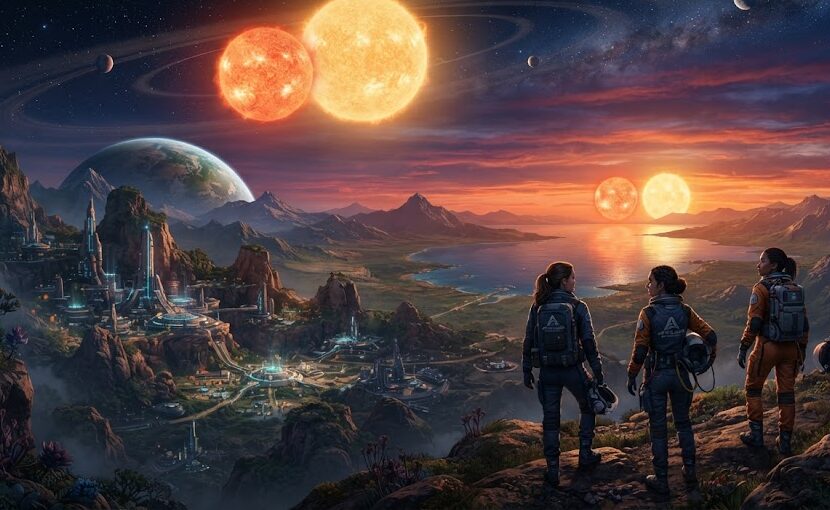
What if our own Solar System had formed as a binary star system? Imagine our familiar golden star — Sol A — partnered with a secondary companion star — Sol B, a smaller K-type orange dwarf or M-type red dwarf.
Could Earth survive in such a dual-star environment? How would the laws of orbital resonance, photosynthesis, and human civilization adapt to a sky with two blazing suns?
1. The Geometry of Survival: P-Type vs. S-Type Orbits
In celestial mechanics, planets in binary systems can only survive long-term in two mathematically stable orbital configurations:
The P-Type (Circumbinary) Orbit: The Tatooine Model
In a P-type orbit, the two stars orbit very close to each other (e.g., separated by only 0.1 to 0.2 AU), and Earth orbits far outside them both at a distance of 1.2 to 1.5 AU.
-
From Earth’s surface, the two stars appear close together in the sky, orbiting one another every few days.
-
Gravitational stability requires the planet to orbit at least 2 to 4 times the separation distance of the twin stars (the critical stability radius, as modeled by Holman and Wiegert).
-
Earth feels the combined gravitational pull of both stars acting almost as a single mass at the center of the system, keeping its planetary orbit stable and circular.
The S-Type (Non-Circumbinary) Orbit: The Nemesis Model
In an S-type orbit, Earth orbits tightly around Sol A at 1.0 AU, while the companion star Sol B orbits at a vast distance — say 50 to 100 AU away (beyond the orbit of Pluto).
- Here, Sol B appears in our sky not as a giant disc, but as an intensely bright point of light — hundreds of times brighter than the full moon — casting sharp nocturnal shadows and banishing absolute darkness for half of the planetary year.
2. Optical and Atmospheric Phenomena
Divergent Dual Shadows
Walking across a field on a circumbinary Earth would be visually surreal:
-
Every human, tree, and building would cast two distinct, overlapping shadows at different angles, depending on the separation of the twin stars.
-
One shadow (cast by the yellow star) would be sharp and dark; the second shadow (cast by the cooler orange or red star) would be softer and tinged with reddish penumbra.
Double Sunsets and Mutual Stellar Eclipses
Sunsets would unfold in cinematic stages:
-
First, the hotter, brighter yellow star dips below the western horizon, turning the sky into a rich, glowing amber-gold.
-
An hour later, the smaller red star sets, painting the sky in deep magenta and crimson twilight.
-
Once every few weeks, the two stars would undergo a mutual stellar eclipse, where one star passes directly in front of the other, causing a sudden, noticeable dip in daylight illumination lasting several hours.
3. The Biology of Two Suns: Black and Violet Flora
Terrestrial plants on Earth appear green because chlorophyll-a and chlorophyll-b absorb blue and red photons while reflecting green light.
Adapting to a Dual Spectrum
In a binary system with a yellow G-type star and a red M-type dwarf:
-
The incoming solar spectrum contains an abundance of both high-energy visible light and low-energy near-infrared (NIR) photons.
-
To maximize energy capture across this broad spectrum, alien plant life would evolve multi-spectral photosynthetic pigments.
-
Rather than bright green, forests and meadows would appear deep charcoal-black, indigo, or royal purple, absorbing virtually all visible wavelengths to synthesize glucose efficiently without suffering thermal radiation damage.
4. Comparative Matrix: Single Star vs. Binary Star Earth
| Planetary Parameter | Single Star Earth (Current) | Circumbinary Earth (P-Type) | Environmental Consequence |
|---|---|---|---|
| Shadow Dynamics | Single shadow; predictable angle | Double distinct shadows | Divergent shadow angles; unique optical illusions. |
| Day-Night Rhythm | Strict 24-hour diurnal cycle | Variable daylight duration | Daylight periods oscillate depending on stellar separation. |
| Plant Coloration | Predominantly Green (Chlorophyll) | Black, Dark Purple, or Bronze | Pigments evolve to absorb both visible and infrared light. |
| Seasonal Predictability | Smooth, predictable 4 seasons | Complex multi-harmonic seasons | Cyclic “super-summers” when both stars peak together. |
| Astronomical Eclipses | Lunar & Solar (Rare) | Regular mutual stellar eclipses | Daylight dims significantly during mutual transits. |
| Orbital Zone Width | Narrow Habitable Zone (~0.4 AU) | Wider, dynamic Habitable Zone | Multiple orbital slots viable for life-bearing planets. |
Frequently Asked Questions
Could life survive the gravitational pull of two stars?
Yes. In a circumbinary P-type orbit, the distance between the planet and the central binary is so large compared to the distance between the two stars that gravity feels smooth, stable, and unified, preventing destructive gravitational tidal shear.
Would a binary Earth have seasons?
Yes, but they would be significantly more complex. In addition to seasons driven by Earth’s axial tilt, the planet would experience “stellar beat seasons” — cooler periods when the dimmer star eclipses the brighter star, and hotter periods when both radiate side-by-side.
WhatIfLab Speculative Science Monograph #09. Circumbinary orbital stability limits, Holman-Wiegert resonance metrics, and exobiological photosynthetic spectral modeling.