🚀 Key Scientific Takeaways
- Permanent Bifurcation: One hemisphere is locked into eternal, boiling daylight (temperatures exceeding 60°C/140°F), while the opposite hemisphere freezes under unending polar night (temperatures plunging past -80°C/-112°F).
- The Twilight Ribbon (Terminator Zone): Habitability shrinks to a narrow, perpetual dusk-and-dawn corridor where temperatures equilibrate between 15°C and 25°C, sustaining all surviving planetary life.
- Centrifugal Ocean Redistribution: Without rotational centrifugal bulge pushing water toward the equator, global oceans would migrate toward both poles, forming two massive polar super-oceans separated by a continuous equatorial land bridge.
- Atmospheric Super-Rotational Winds: Extreme thermal gradients between day and night drive relentless gale-force winds exceeding 300 km/h across the terminator boundary, continuously transferring thermal energy.
At this very moment, standing at Earth’s equator, you are hurtling through space at approximately 1,670 kilometers per hour (1,037 miles per hour) due to planetary axial rotation. This relentless spin gives us our 24-hour day-night cycle, generates the Coriolis effect that steers global winds and ocean currents, and creates the centrifugal bulge that maintains equatorial sea levels.
Across the cosmos, however, rotation is not always autonomous. Many exoplanets orbiting close to red dwarf stars — such as Proxima Centauri b and TRAPPIST-1e — are tidally locked (1:1 spin-orbit resonance). Their rotational period equals their orbital period, meaning one side perpetually stares into the blazing fury of their parent star, while the other side faces the infinite, freezing abyss of deep space.
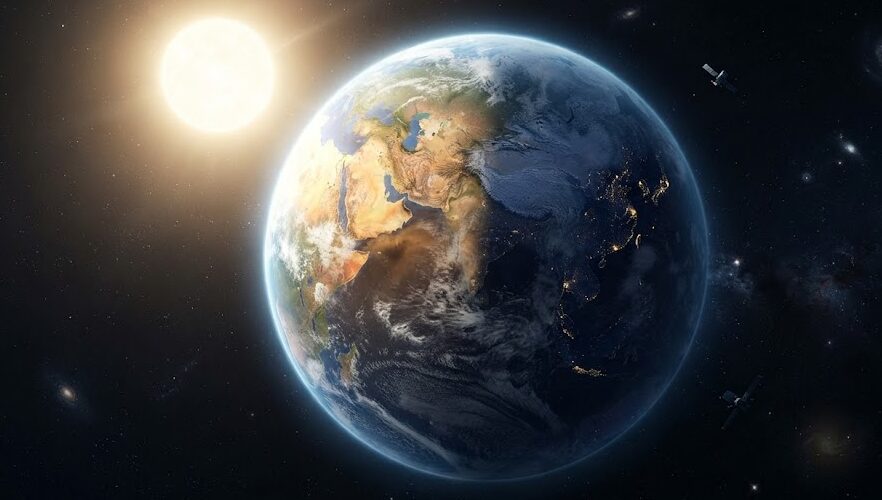
What if Earth suffered this profound celestial fate? If planetary rotation gradually ground to a complete halt relative to the Sun, our dynamic world would transform into an “Eyeball Earth.” Here is the rigorous physics of how our atmosphere, oceans, and civilization would survive the ultimate day-night division.
1. The Physical Transition: Centrifugal Ocean Collapse
The most dramatic physical consequence of a non-rotating Earth does not involve temperature; it involves gravity and oceanic geometry.
The Loss of Equatorial Bulge
Earth is not a perfect sphere; it is an oblate spheroid. Rotation pushes a massive bulge of water and rock around the equator — elevating sea levels by about 8 kilometers compared to a static sphere.
If rotation halts:
-
The centrifugal force drops to zero.
-
Earth’s true gravitational field (which is strongest at the poles because they are closer to the planet’s dense core) takes total control.
-
Global sea levels would immediately undergo a titanic planetary redistribution: trillions of tons of seawater would drain away from the equator and surge toward the North and South Poles.
The Creation of Two Polar Super-Oceans
Geographic modeling reveals that the oceans would split into two distinct polar water basins:
-
The Northern Polar Ocean: Encompassing northern Canada, Greenland, Scandinavia, and Russia under thousands of feet of water.
-
The Southern Polar Ocean: Submerging Antarctica and surrounding southern oceanic basins.
-
The Equatorial Mega-Continent: The middle belt of the planet would dry completely, exposing a colossal continent circling the globe, with dry ocean trenches like the Mariana Trench becoming deep, hyper-dense atmospheric canyons.
2. The Subsolar Point vs. The Anti-Solar Abyss
Once tidal locking is finalized, the two hemispheres diverge into extreme thermodynamic hellscapes.
The Subsolar Scorch (Day Hemisphere)
Directly beneath the permanent zenith of the Sun (the subsolar point):
-
Solar irradiance strikes the ground at a relentless 90-degree angle with zero night cooling.
-
Surface temperatures soar to 70°C to 90°C (158°F to 194°F), evaporating lakes and flash-boiling soil moisture.
-
A permanent, hyper-cyclonic storm system forms over the subsolar point, with rising super-heated air pulling in air from surrounding regions, generating constant electrical tempests and lightning storms.
The Anti-Solar Deep Freeze (Night Hemisphere)
On the opposite side, where sunlight never touches:
-
Temperatures plummet into an unbroken thermodynamic sink of -80°C to -120°C.
-
Atmospheric moisture migrating over from the day side instantly condenses, creating colossal continental glaciers thousands of meters thick.
-
In extreme theoretical scenarios without strong atmospheric heat transport, atmospheric gases like carbon dioxide could freeze directly onto the ground as dry ice, threatening total atmospheric collapse.
3. The Twilight Ribbon: Humanity’s Last Refuge
Between the incinerated daylight desert and the frozen midnight wasteland lies a narrow, circular band called the terminator zone (the twilight ribbon).
The Geography of Perpetual Twilight
In this narrow ring, the Sun rests eternally on the horizon, neither rising nor setting:
-
Stable Temperatures: The balance between warm day-side convective winds and cold night-side advective flows creates a temperate, habitable microclimate hovering between 12°C and 26°C (54°F to 79°F).
-
Dense Ecosystems: Meltwater flowing off the dark-side glaciers toward the day-side deserts feeds massive subterranean aquifers and surface river networks along the terminator, creating a dense emerald ring of flora and fauna.
-
Perpetual Golden Hour: The landscape is illuminated by an unending, cinematic sunset, casting long shadows across strange, phototropic forests adapted to low-angle, reddish-tinted solar spectra.
4. Comparative Matrix: Rotating Earth vs. Tidally Locked Earth
| Environmental Factor | Rotating Earth (Current) | Tidally Locked Earth (1:1 Resonance) | Planetary Outcome |
|---|---|---|---|
| Oceanic Distribution | Equatorial bulge; continuous global ocean | Two isolated polar super-oceans | Massive dry equatorial super-continent exposed. |
| Wind & Weather Dynamics | Coriolis-driven trade winds & jet streams | Radial day-to-night convective super-gales | Fierce, permanent 200+ km/h winds across twilight zones. |
| Day-Night Cycle | 24-hour diurnal rhythm | Infinite Day vs. Infinite Night | Circadian biological clocks obsolete; artificial timekeeping. |
| Agricultural Viability | Global temperate belts | Restricted to the narrow terminator ring | Agriculture requires vertical farming & specialized low-light crops. |
| Planetary Magnetic Field | Strong geodynamo (liquid iron rotation) | Drastically weakened magnetic shield | Slower geodynamo; higher cosmic radiation penetration. |
| Human Habitable Land | ~50% of continental surface | ~5% to 8% (The Twilight Ribbon) | Extreme population concentration in engineered linear ribbon cities. |
5. Civilizational Adaptation in the Twilight Belt
How would eight billion humans survive on a world with only a thin ring of livable land?
Linear Ribbon Megacities
Human architecture would evolve into vast continuous “linear ribbon cities” ringing the planet along the terminator. These cities would anchor themselves deep into bedrock to withstand the ceaseless convective winds blowing from the cold hemisphere to the hot hemisphere. Wind turbines of unprecedented scale would harvest continuous, reliable megawatt power from these eternal thermal storms.
Day-Side Solar Energy & Night-Side Cryo-Mining
The two uninhabitable zones would become industrial hubs:
-
The Day-Desert: Covered in hundreds of thousands of square miles of photovoltaic solar arrays, generating limitless clean energy transmitted to the twilight cities via superconductor conduits.
-
The Night-Glaciers: Mined for pure freshwater ice and used as planetary cryogenic research and data storage centers operating at natural near-absolute temperatures.
Frequently Asked Questions
Could Earth suddenly stop spinning tomorrow?
No. In physics, conservation of angular momentum prevents sudden cessation of planetary spin. The only natural way Earth could become tidally locked is through billions of years of tidal friction or an impossibly massive planetary grazing collision.
Would Earth’s magnetic field completely disappear?
It would be severely weakened. The geodynamo in Earth’s liquid outer core relies heavily on the Coriolis force caused by rotation to organize convective currents into columnar magnetic field lines. Without rotation, the magnetic field would diminish, allowing higher solar wind radiation to reach the upper atmosphere.
WhatIfLab Speculative Science Monograph #03. General Circulation Models (GCM), eyeball exoplanet thermodynamics, and geopotential ocean migration physics.