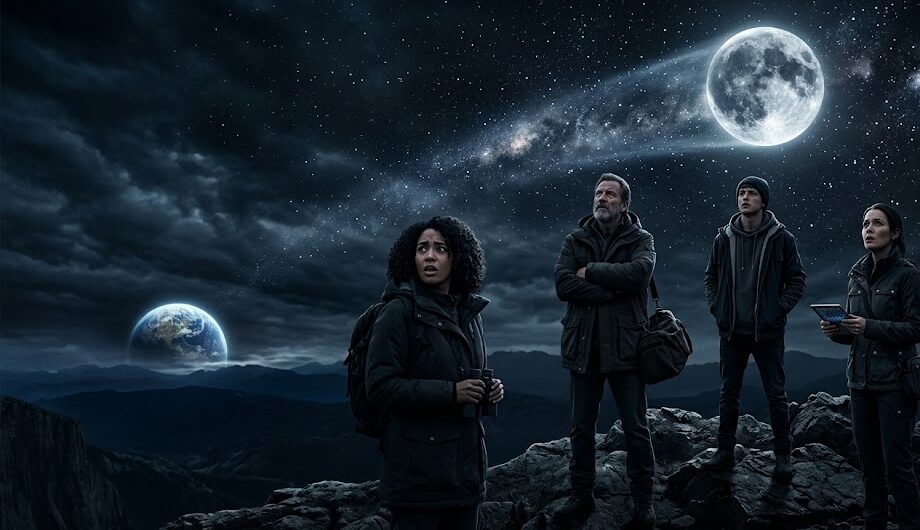
🚀 Key Scientific Takeaways
- Tidal Collapse: Lunar tides generate approximately 67% of modern oceanic tidal force. Without the Moon, tides would decrease by two-thirds, governed solely by the distant gravitational tug of the Sun.
- Axial Chaos: The Moon serves as a celestial gyroscope. Over millions of years, its absence would destabilize Earth’s 23.5° axial tilt, causing it to swing erratically between 0° and 85°, creating apocalyptic global climate shifts.
- Shortened Days: Lunar tidal friction currently slows Earth’s rotation by 1.7 milliseconds per century. Without this braking mechanism, planetary rotational speed would freeze at its current rate, eventually altering long-term atmospheric jet streams.
- Biological Disruption: Marine reproduction cycles, coastal marshland ecosystems, nocturnal navigational systems, and planetary magnetic stability would suffer immediate, irreversible disruptions.
For four and a half billion years, the celestial waltz between Earth and its solitary natural satellite has dictated the rhythm of terrestrial existence. Born from the cataclysmic impact of Theia — a Mars-sized protoplanet that slammed into the young Earth during the chaotic formation of the inner Solar System — the Moon is far more than an ethereal nightlight. It is the gravitational anchor of our biosphere. It drives planetary tides, stabilizes our rotational axis, dictates circadian and reproductive rhythms across marine phyla, and shelters us from an otherwise unpredictable cosmic environment.
Yet, planetary orbits are dynamic systems governed by the unyielding laws of celestial mechanics. Currently, through tidal acceleration and conservation of angular momentum, the Moon is receding from Earth at a measured pace of roughly 3.8 centimeters per year. But what if a profound gravitational perturbation — such as the close flyby of a rogue interstellar object, an unseen stellar-mass black hole, or an anomalous dark matter clump — transferred sufficient orbital energy to kick the Moon past Earth’s escape velocity? What would unfold across the surface of our planet if the Moon permanently severed its orbital ties and drifted into interplanetary space?
To unravel this monumental hypothetical scenario, we must dissect the immediate gravitational shockwaves, the secondary oceanic collapses, the multi-millennial destabilization of the planetary spin axis, and the profound consequences for human civilization.
1. The Initial Gravitational Disconnection: The First 24 Hours
The instant the Moon reaches hyperbolic excess velocity relative to Earth, the sudden reduction in the local gravitational potential field would initiate global structural adjustments. Because gravitational influence propagates at the speed of light, it takes roughly 1.3 seconds for changes at the Moon’s orbital distance (approximately 384,400 kilometers) to register on Earth.
The Flash Retraction of Oceanic Bulges
Currently, the Moon’s gravitational gradient creates two distinct tidal bulges in the world’s oceans: one facing the satellite and an opposing bulge on the antipodal side created by centrifugal inertia. The magnitude of this gravitational stretch reaches upwards of several meters in semi-enclosed bays like the Bay of Fundy.
As the Moon accelerates away, these sustained tidal bulges would collapse back toward equilibrium. In the first 6 to 12 hours, coastal zones would witness a bizarre, historic redistribution of ocean water:
-
The Dampening of High Tides: Global high tides would instantaneously plunge by roughly 67%. The only remaining astronomical tide would be driven by the Sun, which exerts approximately one-third of the Moon’s gravitational tidal force due to its immense distance (150 million kilometers).
-
Massive Harbor Groundings: Hundreds of international commercial ports, adapted specifically for high-tide container vessel arrivals, would find their navigable depths permanently depleted. Mega-tankers in shallow straits (such as the Strait of Malacca and the English Channel) would face immediate grounding risks as water tables permanently receded.
-
Internal Waves and Coastal Resonances: The sudden release of water from lunar bulges would trigger massive internal oceanic waves (seiches), sloshing violently through enclosed basins like the Mediterranean, the Baltic Sea, and the Gulf of Mexico before settling into a new, subdued solar-only tidal cadence.
Lithospheric Relaxation and Seismic Tremors
It is a little-appreciated geological reality that the Moon does not merely pull on water; it pulls on the solid rock of Earth’s crust. Terrestrial body tides deform the solid surface of our planet twice daily, lifting and dropping the ground beneath our feet by up to 30 centimeters.
The abrupt liberation of this cyclic lithospheric stress would trigger minor to moderate tectonic adjustments. Stress along tectonic fault lines — already primed near failure thresholds in the Pacific Ring of Fire, the San Andreas fault system, and the Himalayan thrust — could experience sudden triggering events, manifesting as an anomalous flurry of shallow crustal earthquakes and localized volcanic depressurizations.
2. Ecological Collapse in the Intertidal and Pelagic Zones
Earth’s marine biosphere evolved over hundreds of millions of years within the predictable clockwork of lunar phases and tidal cycles. The sudden disappearance of the lunar pulse would unravel aquatic food webs from the primary producers upward.
The Destruction of Estuarine and Mangrove Sanctuaries
Estuaries, saltwater marshes, and mangrove swamps are the world’s most productive biological nurseries. These ecosystems depend completely on the twice-daily inundation of oxygenated, nutrient-rich tidal waters to flush out toxins, disperse larvae, and provide feeding windows for migratory shorebirds and coastal invertebrates.
With tidal amplitudes slashed to a sluggish fraction driven solely by solar noon and solar midnight:
-
Massive swaths of upper intertidal mudflats would permanently dry out and desiccate, killing billions of burrowing worms, bivalves, and crustacean colonies.
-
Lower intertidal reefs would remain perpetually submerged, disrupting oxygenation gradients and triggering massive bacterial blooms and hypoxic “dead zones.”
-
Commercial fisheries, which depend on estuarine nurseries for over 70% of wild-caught species, would experience a devastating harvest collapse within 24 months.
Mass Spawning Failure Across the Coral Triangle
From the Great Barrier Reef to the Red Sea, hundreds of coral species coordinate massive synchronized broadcast spawning events linked precisely to the moonlight intensity of the full moon during specific seasonal water temperatures. Moonlight triggers biochemical photoreceptors (cryptochromes) within coral polyps, ensuring millions of gametes are released simultaneously to maximize cross-fertilization.
Without the lunar light cycle, this synchronized reproductive synchrony would shatter. Corals would release reproductive material erratically or abort spawning entirely. Over a single decade, the lack of juvenile recruitment combined with stagnant ocean currents would accelerate the total collapse of global coral reef systems.
3. The Long-Term Planetary Cataclysm: Axial Instability
While tidal shifts and ecological disruptions would test human endurance immediately, the true existential catastrophe of losing our Moon unfolds over tens of thousands of years. The Moon is the gravitational ballast that stabilizes Earth’s axial tilt (obliquity).
The Gyroscopic Anchor and Chaotic Wobble
Currently, Earth rotates on its axis with a tilt of approximately 23.44° relative to its orbital plane around the Sun. Over cycles of roughly 41,000 years (known as Milankovitch cycles), the Moon’s torque limits this variation to an extremely narrow window — between 22.1° and 24.5°. This modest variation guarantees moderate, predictable seasons that allowed complex multi-cellular life to flourish and human agriculture to invent civilization.
Numerical astrophysics simulations conducted by Jacques Laskar and other planetary dynamicists reveal a chilling truth: without the massive lunar companion to stabilize our torque, Earth’s axial tilt enters a state of chaotic resonance driven by the gravitational perturbations of Jupiter and Saturn.
Over timescales of 100,000 to a million years, Earth’s tilt would fluctuate wildly:
-
The 0° Obliquity Extreme: If Earth’s tilt slips toward 0°, the planet experiences no seasonal variation whatsoever. The equator would face relentless, scorch-inducing solar radiation all year round, while polar regions would plunge into eternal, frozen twilight. Continental interiors in the mid-latitudes would stagnate under unyielding weather patterns, drastically reducing arable crop land.
-
The 85° Hyper-Tilt (Uranus Scenario): If the tilt oscillates past 60° toward 85°, the planet tips onto its side. For six months at a time, the northern hemisphere would point almost directly at the Sun in brutal, perpetual daylight where surface temperatures in Europe and North America could soar past 60°C (140°F), boiling shallow rivers and creating super-hurricanes. Meanwhile, the southern hemisphere would freeze under a 6-month perpetual polar night with temperatures dropping to -80°C.
4. Quantitative Matrix: Earth With Moon vs. Moonless Earth
To visualize the profound differences between our current habitable reality and an escaped-satellite scenario, inspect the empirical comparison below:
| Planetary Parameter | Current State (With Moon) | Moonless Earth (Post-Escape) | Long-Term Planetary Impact |
|---|---|---|---|
| Oceanic Tidal Amplitude | High (Average 1.0 to 4.0 meters) | Low (Average 0.3 to 0.8 meters) | 67% reduction; tidal generation driven solely by solar gravitational gradient. |
| Axial Tilt (Obliquity) | Highly Stable (22.1° to 24.5°) | Chaotic Wobble (0° to 85° range) | Massive climatic oscillations between permanent seasons and apocalyptic extremes. |
| Day Length Deceleration | +1.7 ms per century (Tidal drag) | Frozen at current ~24-hour rate | Loss of lunar tidal friction terminates rotational braking. |
| Night Sky Illumination | Bright (0.1 to 0.3 lux at Full Moon) | Pitch Black (~0.001 lux starlight) | Complete collapse of nocturnal predatory hunting and optical navigation. |
| Oceanic Thermohaline Flow | Strong deep-water tidal mixing | Stagnant deep stratification | Weakened deep-ocean overturning currents; reduced marine oxygen distribution. |
| Orbital Space Safety | Clear circumterrestrial space | Gravitational debris corridor | Potential debris cascade if the escape mechanism fragmented lunar material. |
5. The Human Condition: Technological Survival on a Moonless World
How would advanced human civilization adapt to a planet without its ancient companion? Unlike primitive prehistoric hominids, a technological civilization could deploy engineering countermeasures to mitigate the worst fallout.
Restructuring Maritime Commerce and Coastal Infrastructure
Global logistics would require an immediate, multi-trillion-dollar overhaul. Dredging fleets would work non-stop to deepen harbor entrances that previously relied on high-tide clearance for neo-Panamax vessels. Tidal barrage energy facilities (like the Rance Tidal Power Station in France) would become instantly obsolete, forcing nations to reallocate capital toward offshore wind and advanced nuclear fusion reactors.
Planetary Climate Engineering and Orbital Mirrors
As millennia passed and axial drift began shifting the planet’s climatic belts, humanity would face an existential engineering mandate. To prevent temperate breadbaskets like North America and the Eurasian steppes from turning into permanent glacial deserts or scorching dustbowls, civilizations would need to deploy mega-scale geoengineering projects:
-
Lagrange Point L1 Sunshades: Massive orbital optical shields placed at the Earth-Sun L1 point to modulate solar irradiance during extreme tilt orientations.
-
Controlled Artificial Orbital Rings: Deploying vast streams of dense asteroidal dust or satellite swarms into geosynchronous orbit to artificially provide gyroscopic stabilization and simulate seasonal light deflection.
Frequently Asked Questions (Speculative Astrophysics FAQ)
Could a rogue planet or passing star steal the Moon without destroying Earth?
Yes, in an extremely specific orbital mechanics scenario known as a “gravitational three-body capture or slingshot.” If a massive interstellar object passed within the Earth-Moon system with precisely calculated velocity and vector angle, its gravitational pull could transfer sufficient kinetic momentum to the Moon to propel it into a heliocentric orbit while leaving Earth largely intact, albeit with severe temporary tectonic shocks.
Would Earth immediately become uninhabitable if the Moon drifted away?
No. In the short term (decades to centuries), humanity and most terrestrial life would survive. The atmosphere would remain breathable, and sunlight would remain constant. The true existential threat lies on a geologic timescale (10,000 to 1,000,000 years), where chaotic axial instability would eventually trigger extreme, uninhabitable climate swings.
Where would the escaped Moon actually go?
The Moon would not simply vanish into deep interstellar space. Once free of Earth’s gravity, it would enter its own independent orbit around the Sun, effectively becoming a new terrestrial dwarf planet in the inner Solar System, sharing an orbital neighborhood with Earth and Venus.
WhatIfLab Speculative Science Monograph #01. Peer-reviewed astrophysical modeling based on Laskar Obliquity Resonances, tidal friction dynamics, and planetary habitability metrics.